Queens Man Launches Movement to Reclaim 'A.I. Slop' as a Term of Pride, Pending Community Board Approval

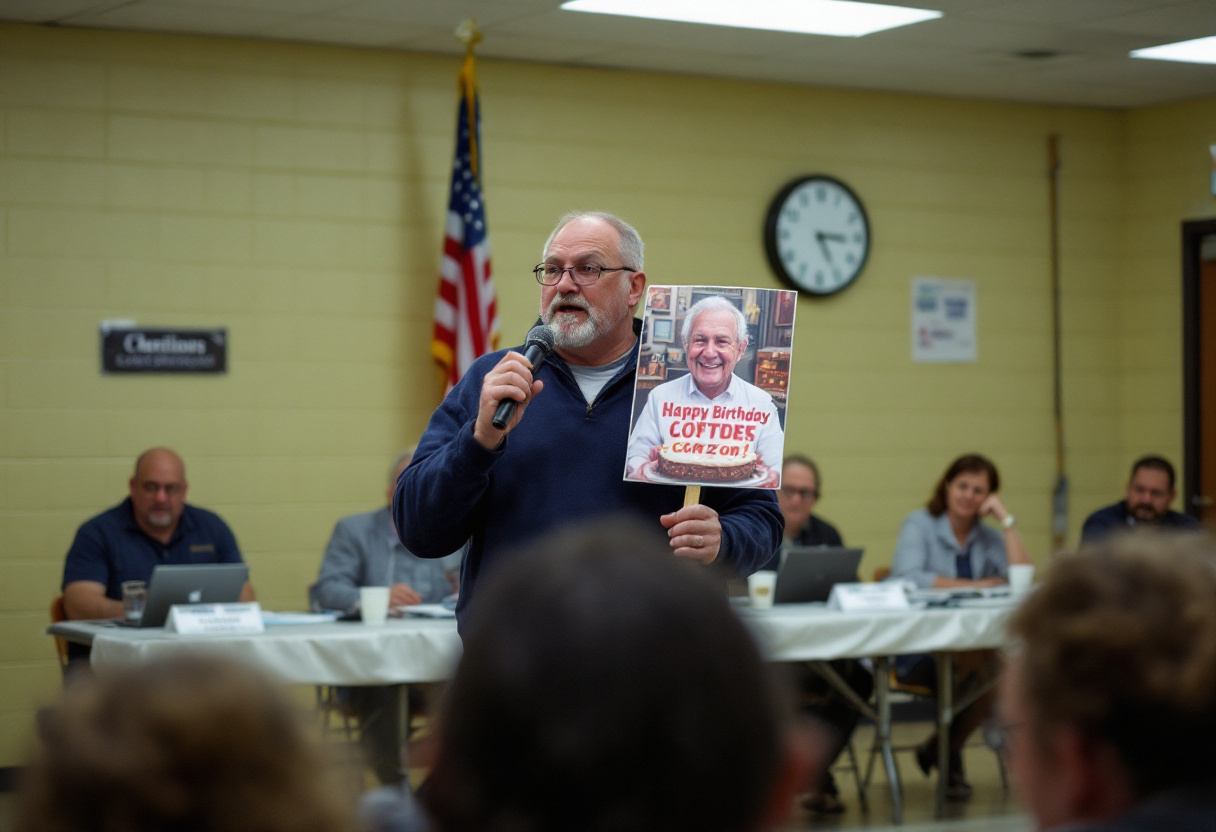
SUNNYSIDE, Queens — A 47-year-old Sunnyside man who has published an estimated 1.2 million computer-generated images, e-books and inspirational captions since at least the third quarter of 2023 appeared before a Queens community board committee on Tuesday night to request a street activity permit for what he described as the first public march in the history of the movement to reclaim the term “A.I. slop,” according to the committee’s agenda, a recording of the meeting and the permit application itself, a copy of which was obtained by The New York Time5.
The man, Lowell Pruett, a former insurance claims adjuster, operates a network of 212 social media pages and has self-published approximately 1,400 e-books, among them a nine-volume history of the Byzantine Empire that he produced over a single weekend in March. He is the founder of Slop Nation, an advocacy organization incorporated in New York State in August which exists, according to its certificate of incorporation, “to restore dignity to a word that was used against us before we were in a position to use it ourselves.” In remarks to the committee that lasted eleven minutes against a posted limit of three, Mr. Pruett placed the effort in what he called “a clear historical line.” “‘Queer’ was a slur, and it was taken back. ‘Slut’ was a slur, and it was taken back,” he said. “Nobody handed those words back. People took them. We are taking ‘slop.’” Asked by a committee member whether he had studied those movements, Mr. Pruett said that he had, closely, in summary form.
The application, filed on Sept. 30 with the city’s Street Activity Permit Office, requests the closure of one lane of Skillman Avenue between 43rd and 50th Streets for three hours on a Saturday in November, for an event identified as the Queens SlopWalk. It lists expected attendance at forty people and, under the heading “signage,” approximately 1,100 placards, every one of them generated by the same software whose output the march is intended to honor. Committee members noted that the sample placard submitted with the application depicted an elderly man holding a birthday cake inscribed “Happy Birthday Coftdes Corzon,” and asked whether the remaining placards would be legible. Mr. Pruett replied that legibility was “a standard we were never consulted on.”
Rosalind Ferrante, who has chaired the board’s Transportation Committee since 2017 and has presided over, by her own count, roughly 340 street activity permit reviews, said after the meeting that the committee’s jurisdiction was limited to traffic, sanitation and public safety. “We do not rule on the meaning of words,” Ms. Ferrante said. “We rule on whether a bus can get through.” She noted, however, that the proposed route would pass two schools, a Saturday greenmarket and a senior center, and that the committee had received seventeen written comments on the application, fourteen of which were, in her description, “visibly generated.” Ms. Ferrante declined to say whether she had read the fourteen comments in full. The committee voted 5 to 0, with one abstention, to table the application until its November meeting, pending a revised sanitation plan. Mr. Pruett said a revised plan had been drafted before he returned to his seat.
Dr. Miles Westergaard, a professor of linguistics at the University of Michigan and the author of Drift: How English Words Change Meaning Whether You Like It or Not, said in a telephone interview that reclamation was “among the most thoroughly documented processes in the lexicon” and that there was no reason in principle Mr. Pruett could not succeed. “Words do not ask permission, and they do not stay where they were put,” Dr. Westergaard said. “There is one technical obstacle, which is that every successful reclamation I am aware of involved a word that had been applied to people. ‘Slop’ has been applied to the output.” Informed of the distinction, Mr. Pruett said he did not recognize it. “I am what I produce,” he said. “If they call it slop, they are calling me slop. I am asking them to keep doing it, only louder, and with respect.”
Not every party with a stake in the word agrees that it requires reclaiming. Dr. Marguerite Sable, director of the Institute for Applied Protein Recovery in Battle Creek, Mich., said that “slop” has designated a liquid feed of kitchen and processing residues, given principally to swine, since at least the seventeenth century, and that it carried no shame among the people who mixed it or the animals who ate it. “It is a complete ration. It was never an insult until it was borrowed for one,” Dr. Sable said. “The word does not need to be reclaimed. It needs to be returned.”
The committee’s next meeting is scheduled for Nov. 18 at 7 p.m. in a public school cafeteria on 43rd Avenue, where it has met on the third Tuesday of every month since an estimated 2011. Mr. Pruett said that Slop Nation would attend regardless of the outcome, and that its members had already adopted a chant, which he performed for the committee before his microphone was switched off: “We’re here, we’re slop, and we will not stop.” The meeting minutes, posted to the board’s website on Wednesday afternoon, record the chant as “public comment (continued).”