Senator Introduces Bill to Dissolve the Canadian Border, Arguing That a Mass Influx of Canadians Would Improve the Country
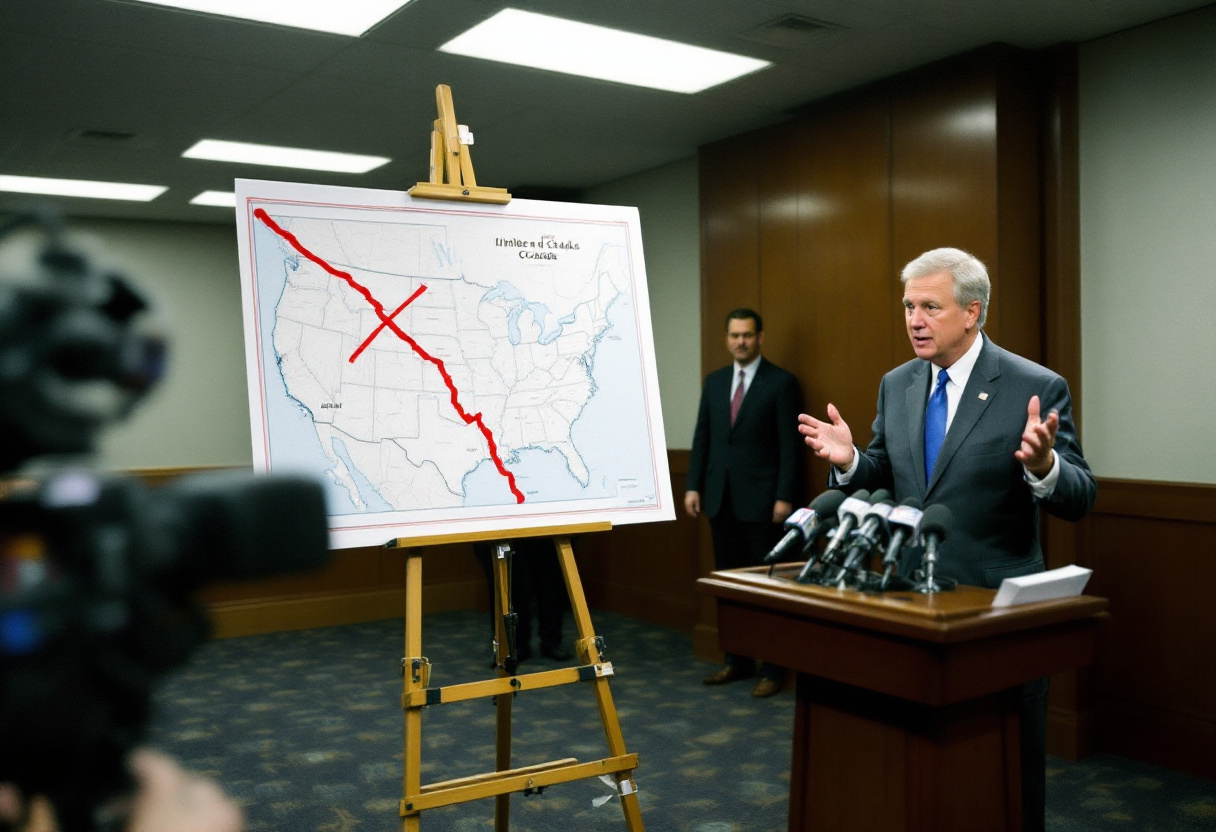
WASHINGTON — The bill, introduced Tuesday and referred within the hour to the Committee on Homeland Security and Governmental Affairs, the Committee on Foreign Relations, and the Committee on the Judiciary — a tripartite referral that aides on all three panels described as “unusual” and at least one described as “possibly unprecedented for a measure of this length” — runs to nine pages and would, in its operative section, abolish the international boundary between the United States and Canada.
The legislation, formally titled the Northern Boundary Elimination and National Improvement Act but referred to by its sponsor as “the good-neighbor bill,” was introduced by Senator Warren Briscoe, Republican of Kansas — the same senator who last year proposed dividing the United States into two sovereign nations, and who now proposes, in what he characterizes as a natural refinement of that thinking, enlarging it by one. The bill would permit the unrestricted entry of Canadian citizens across the whole of the 5,525-mile border and, in its findings section, expressly encourages them to come.
“You have a field on one side of a fence that has been managed well, and a field on the other side that has not,” Mr. Briscoe, Republican of Kansas, said at a news conference on Tuesday, standing beside a map of the border on which the border had been crossed out. “The responsible thing, agronomically, is to take down the fence and let the good soil come across.” He described the movement the bill anticipates as “voluntary inundation,” and said that its supporters had “no interest in slowing it down and every interest in speeding it up.”
The premise of the legislation, stated across four pages of findings and elaborated at some length on Tuesday, is that a large and sustained influx of Canadians would materially improve the United States — a conclusion the bill supports with citations to comparative rankings in infrastructure maintenance, unprompted apology, orderly queuing, and what the text calls “civic temperament.” A co-sponsor, Senator Marion Aldridge, Democrat of Oregon, said the measure had emerged from “a bipartisan recognition, arrived at independently and then confirmed over several years, that the problem is not our borders but what is inside them.” She declined to elaborate, saying only that the bill “speaks for itself, which is more than I can say for most of us.”
The proposal has drawn the attention of the Georgetown Center for Sovereign Partition Studies, which maintains a database of 143 partition events dating to 1494 and which found itself, for the first time in its history, consulted on the reverse operation. “We have catalogued the creation of borders in exhaustive detail, and we have a well-developed vocabulary for it,” said Dr. Elspeth Thorngaard, the Center’s senior research fellow. “We do not have a word for a nation that voluntarily dissolves a functioning border in order to be overrun by a population it considers an improvement. Taxonomically, this is a gap. We are working on it.”
Not all reaction was favorable. Senator Gerald Frisch, Republican of Ohio, who sits on the Committee on the Judiciary, called the bill “constitutionally unserious,” noting that “there is no provision in the founding document for inviting an invasion, chiefly because the men who wrote it could not conceive of a country that would want one.” Sources familiar with the referral process said the more immediate obstacle was jurisdictional: because the bill simultaneously concerns homeland security, foreign relations, and immigration, no committee has yet claimed it, and a hearing scheduled for later this month was postponed after the three chairmen were unable to agree on which of them should gavel it in.
In Ottawa, the response was cooler. A spokesman for Global Affairs Canada, Denis Charbonneau, said the government had “no plans to invade the United States, now or at any point,” and added that Canada “was grateful for the sentiment but would prefer, on the whole, to remain where it is.” He said that most Canadians contacted by the ministry over the preceding week had “expressed a general willingness to help but a strong and repeatedly stated preference not to move,” and that the government considered the matter “very kind and, respectfully, closed.”