Man Who Once Talked to Himself Now Only Rants to Himself, and Says He Tries Not to Take It Personally

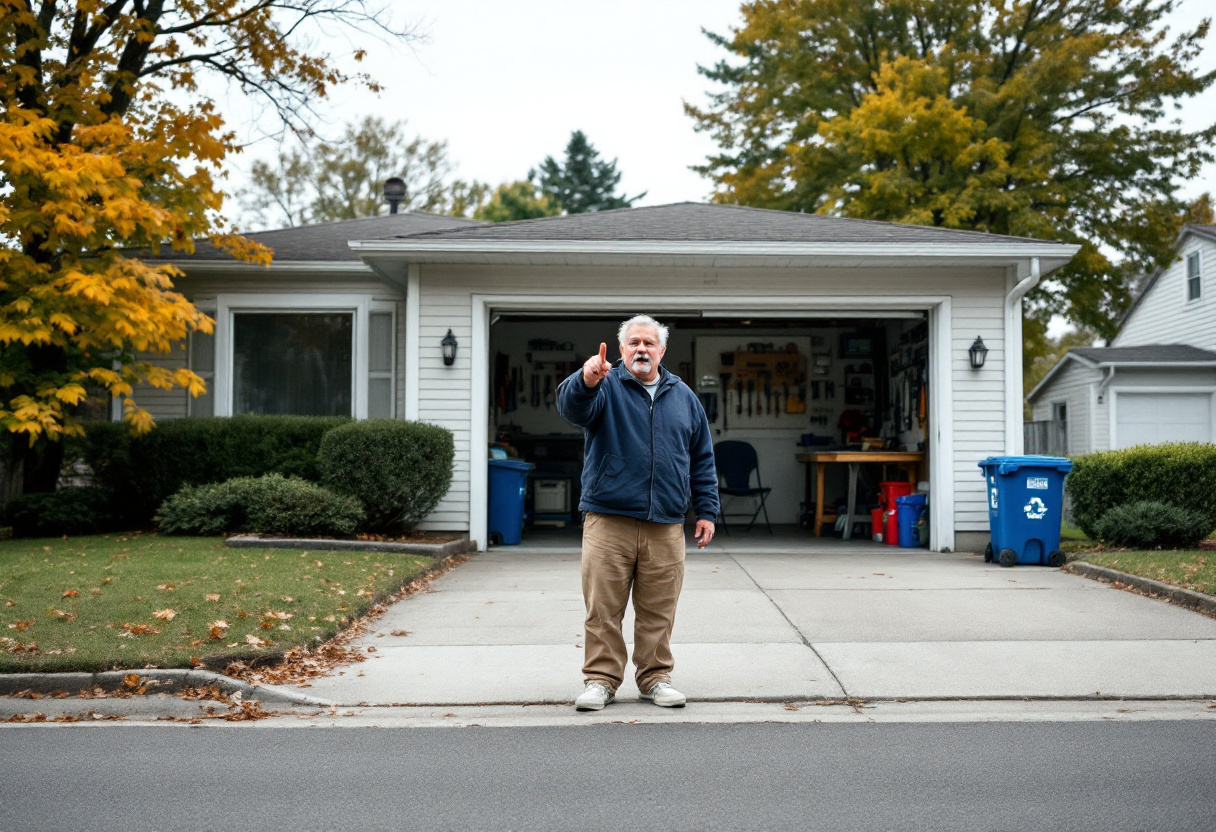
PARAMUS, N.J. — The garage is, by any measure, a well-run garage. The pegboard along its back wall holds forty-one hand tools, each hung inside an outline of itself drawn in black marker, so that an absence can be detected from the street; the shelving opposite holds coffee cans of sorted fasteners, labeled in a hand that filled out, by its owner’s estimate, some eleven thousand inspection reports; and beside the workbench stands a folding chair at which, on most afternoons for the better part of four decades, Phil Amato has sat and talked things over with himself. Mr. Amato, 67, retired in 2024 after thirty-four years as a housing inspector with the Borough of Paramus Department of Code Enforcement, a career conducted largely in crawl spaces, utility closets and unfinished basements — rooms in which, as he put it, “the only other guy down there is you.”
The conversations, by every available account, were good ones. Mr. Amato would ask himself where the electrical panel was likely to be, tell himself it would be behind the water heater, find it behind the water heater, and say, “Naturally.” He would ask whether a stair rail was plumb and defer to the answer. He would propose a left onto Route 4 and then, on reflection, talk himself out of it. He argued with himself about the Giants’ offensive line for the whole of the 2011 season and conceded in February that he had been right. In summer, with the windows open, the neighbors on East Ridgewood Avenue heard all of it through the screens and came to regard it as a feature of the block, like the ice cream truck or the leaf blowers on Saturday morning. “It had a back-and-forth,” said Dennis P. Hagerty, who lives next door. “You could hear him wait.”
Sometime last fall — no one on the block agrees exactly when, and Mr. Amato does not recall a particular day — the waiting stopped. Mr. Amato no longer talks to himself. He rants to himself: sustained, unbroken addresses of between eleven and forty minutes, delivered at the workbench or on the way to the curb with the recycling, on the northbound jughandles of Route 17, the self-checkout lanes at the ShopRite, the out-of-state drivers who arrive at the Garden State Plaza on Sundays in apparent ignorance of the borough’s blue laws, and a deck on the next street over whose balusters he has estimated, from the sidewalk, at four and five-eighths inches apart. The party being addressed, a full participant for thirty-four years, no longer gets a word in. Mr. Amato appeared briefly in these pages in March, retrieving his bins from the curb and offering a measured assessment of a neighbor’s bidet. He was, it now emerges, measured with everyone but himself.
“I used to be good company,” Mr. Amato said on Tuesday, seated on an overturned five-gallon bucket beside the workbench, the folding chair, for reasons he did not explain, left empty. “I’d put a question to me, I’d think it over, I’d get back to me. There was respect in it. Now I come through that door and I just start in. I don’t let me finish. I’m aware that I don’t let me finish.” Asked how it felt to be on the receiving end, he was quiet for a moment. “I try not to take it personally,” he said. “It isn’t about me. I know that. I know where I’m coming from.”
Mr. Hagerty, speaking at the property line with a mug of coffee, said the change was audible from his kitchen. “It used to sound like two guys working on a car,” he said. “Now it’s one guy, and there’s no car.” He then asked whether this reporter had ever heard an echo that did not wait for him to finish talking. He did not elaborate.
In June, at the urging of his daughter, Mr. Amato began seeing Dr. Judith Fenn-Caraway, a clinical psychologist in Ridgewood who specializes in marital communication and who, with his permission, agreed to discuss the case in general terms. She said she had considered a referral and concluded that the presentation fell squarely within her practice. “I don’t have an intake form for this, so I used the couples form and filled it out twice,” she said. “What I see in the room is very familiar. For thirty-four years these two had a shared project, which was whatever building was in front of them, and the conversation was organized around it. When a couple loses the shared project — the children leave, the business is sold, somebody retires — one of two things happens. They find a new project, or one of them starts talking and the other one starts being talked at.” She said that at this stage she would ordinarily ask the quieter partner what he wanted. She paused. “I did ask,” she said. “He had a great deal to say.”
It would be possible to regard all of this as a private matter between two parties who happen to share a body, a mortgage and a garage, and Mr. Amato would prefer that it be regarded that way. It is harder to do so after an hour on the telephone with Dr. Terrence Kolbeck, director of the Center for Discursive Throughput at the University of Michigan, whose federal study, delivered to the Senate last month, found that the average American’s political position cannot be spoken aloud in the time any listener will allow. Self-directed speech, Dr. Kolbeck said, has been the one standing exception in the literature — the only channel in which the listener already holds the speaker’s entire position, requires none of it explained, and cannot be handed the wrong first clause. “A man talking to himself is the only conversation in the country with a fidelity of one hundred percent,” he said. “No — let me put that another way. It was the only conversation in the country that worked. There is nothing to transmit. The listener already has all of it.” He stopped, and began again. “So when that conversation becomes a rant, you have to ask what the rant is for. On our data, it isn’t for anything. It’s what speech does once it has run out of people who haven’t already heard it.”
Mr. Amato, read this assessment in the garage, considered it for some time. “It’s the jughandle,” he said.
Late Tuesday afternoon he walked the blue bin down the driveway and, somewhere between the garage and the curb, began on the deck on the next street over. At the curb he stopped. He asked himself, quietly and in something nearer his old voice, whether he had locked the side door. Then he stood at the foot of the driveway for a while, waiting, and — having received no answer — walked back up to check.