Physicist Who Refuses to Read Philosophy Has Spent Eleven Years Deriving It From First Principles, Arriving at 1785

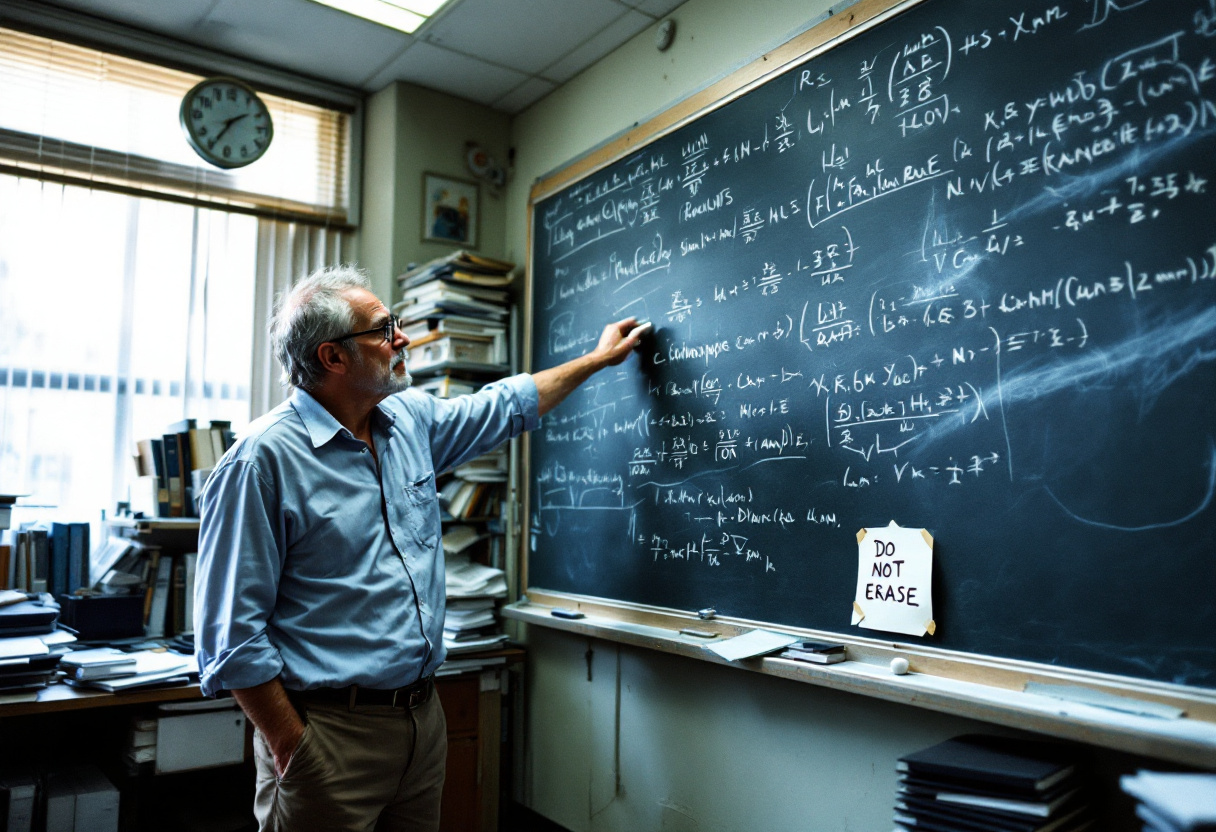
PASADENA, Calif. — Dr. Anders Ruhl, 54, a professor of theoretical physics at the California Institute of Technology, has never read a book of philosophy. He does not own one. He does not intend to acquire one. For the past eleven years he has instead been deriving philosophy himself, from first principles, in a run of eighteen black hardbound notebooks he refers to as the Framework — 1,100 handwritten pages that scholars who have now read them describe as an unassisted, largely correct and almost entirely redundant reconstruction of Western thought between the years 1637 and 1785.
The Framework contains no citations. It contains no bibliography. It contains, according to Dr. Ruhl, nothing he did not put there himself, which is the point. He derived the cogito in 2015 on a delayed flight to Geneva and recorded it on a cocktail napkin now taped into Notebook Two: “I am thinking. Something is therefore doing that.” He spent the better part of 2017 establishing that no number of past sunrises entails a future one, a result he filed under the heading “The Induction Thing” and which he says cost him a grant. In 2019 he proved to his own satisfaction that a description of the world can never by itself yield an instruction, a barrier he named Ruhl’s Wall. In 2021, while assembling the notebooks into a single document, he noticed that he believed each page of the Framework to be true while also believing the Framework as a whole to contain errors, and he devoted forty pages to the contradiction before setting it aside as unresolved under the heading “Ruhl’s Uncertainty of Compilation.” And in March 2023, working at the chalkboard in his office, he arrived at the principle that one should act only in ways one could will to be universal, wrote it at the top of Notebook Fourteen, and labeled it “Rule 1.”
“Philosophy is what you do when you cannot do the calculation,” Dr. Ruhl said, in an interview in his Pasadena office, where the chalkboard has not been erased since 2023 and a sign reading DO NOT ERASE has been supplemented by a second sign reading THIS MEANS FACILITIES. “If a result is correct, I will get to it. If I cannot get to it, it was not a result. I do not require a German to tell me what I can obtain in an afternoon.” Asked whether he had considered simply reading Kant, Dr. Ruhl said that reading Kant would be assuming the conclusion. He has been given a copy of the Critique of Pure Reason on four occasions, most recently by his own department chair. He weighed it in one hand, he said, and returned it. “This is not a first-principles document,” he recalled telling her. “This is somebody’s notes.”
The reconstruction went undetected for most of a decade, in part because nobody in the building had any reason to check. It was noticed at last by Devon Achterberg, 29, a postdoctoral researcher in Dr. Ruhl’s group, who had taken an undergraduate ethics course and who keeps a paperback Groundwork in a desk drawer for reasons he describes as sentimental. Mr. Achterberg began quietly cross-referencing the notebooks in 2023 and has maintained a private spreadsheet ever since. “He derived the categorical imperative on a Tuesday afternoon and then went to a faculty meeting,” Mr. Achterberg said. “I went home and lay on the floor. He was very pleased with Rule 1. He said it fell out of the symmetry, which — I want to be fair to him — it does.”
Mr. Achterberg’s spreadsheet eventually reached the Center for Computational Epistemology at Carnegie Mellon University, which ran the Framework against its database of the philosophical literature and produced the first formal audit of an independent derivation of an entire discipline. Of the 1,100 pages, the center matched 1,079 to prior work, with a median lag between original publication and Ruhl rederivation of 238 years. The forty pages Dr. Ruhl set aside as unresolved in 2021 were identified as the preface paradox, described in four pages in 1965. “Twenty-one pages of the Framework are, so far as we can determine, genuinely original,” said Dr. Arthur Goode, a senior fellow at the center. “They are also, in our assessment, the weakest twenty-one pages. I want to be precise about what I am saying. He is at his best when he is being unoriginal, and he is unoriginal for ninety-eight percent of the manuscript, and so for ninety-eight percent of the manuscript he is very good.”
Within physics, the response has been what researchers are now calling unremarkable. Dr. Helene Marquardt, who holds the Enrico Fermi Chair in Particle Theory at Columbia University, said she saw no cause for alarm and some cause for congratulation. “Well, the short answer is that this is how the field works,” Dr. Marquardt said. “We are trained to distrust anything we have not obtained ourselves, and the training takes. Physicists have been rederiving philosophy without attribution since roughly 1900, and in the standard formulation we call that physics. That Dr. Ruhl did it in longhand, and got the ethics as well, is a matter of thoroughness. I would not read anything further into it.”
D.C. Makinson, the logician who identified the preface paradox in 1965 and has spent the six decades since being asked to solve it, read the Framework in full at this newspaper’s request. He was, on the whole, admiring. “It is, I think, not unreasonable to suggest that Dr. Ruhl has done the work,” Mr. Makinson said. “He has simply done it twice, and one of the times was not necessary. His forty pages on the paradox are careful and they are honest and they arrive precisely where the literature arrives, which is nowhere. I have named it after a preface. He has named it after himself. I do not begrudge him this. He got there the hard way, which is more than I can say for a number of my correspondents.” He added, after a pause: “I would only observe that the shortest route to Chapter Two is Chapter One.”
What the Framework could mean for ordinary Americans is, at present, unclear. Dr. Ruhl has derived no applications and expects none, on the grounds that applications are downstream. He has already begun Notebook Nineteen, which he has opened on a new problem: how a physical system composed of ordinary matter comes to have an interior experience of anything at all. He refers to this in his notes as “The Consciousness Thing.” He expects to close it in eighteen months. “It cannot be that hard,” Dr. Ruhl said. “Someone would have said something.”