New Paper Argues the Earth Is a Flat Dachshund, a Conclusion Its Authors Call Coherent, Empirically Adequate and Useless

WOODINVILLE, Wash. — A new paper submitted this year to a peer-reviewed geodesy journal argues that the Earth may be shaped like a dachshund, that it may furthermore be perfectly flat, and — most consequentially, its authors contend — that no experiment ever performed or ever conceivable could prove otherwise. The paper, On the Admissibility of Canine Geodesy: The Earth as a Dachshund, with a Defense of the Defensible Flat Earth, was written by P. Reinholdtsen, an independent researcher and the proprietor of Bitsy Services LLC, a consultancy in Woodinville, together with Claude, an artificial intelligence system developed by Anthropic to which, the paper specifies, correspondence should not be addressed. It advances what its authors call the Defensible Flat Earth, a model they describe as coherent, empirically adequate and, by their own admission, useless. It was rejected by the Journal of Recreational Geodesy and is, according to its own cover page, now “under review at a venue with lower standards.”
The reasoning proceeds from a principle long familiar to philosophers of geometry and almost no one else. Following the physicist Hans Reichenbach, the paper observes that the shape of physical space is fixed by experiment only up to a convention: any measurement consistent with a round Earth can be made equally consistent with a differently shaped Earth by positing what Reichenbach called “universal forces,” hypothetical influences that act identically on every ruler, clock and beam of light and are therefore, by construction, impossible to detect. Under such a force, the paper argues, the spherical excess in a surveyor’s triangles, the way ships vanish hull-first over the horizon, and the punishing duration of the Sydney-to-Santiago flight are all reproduced exactly on a dachshund.
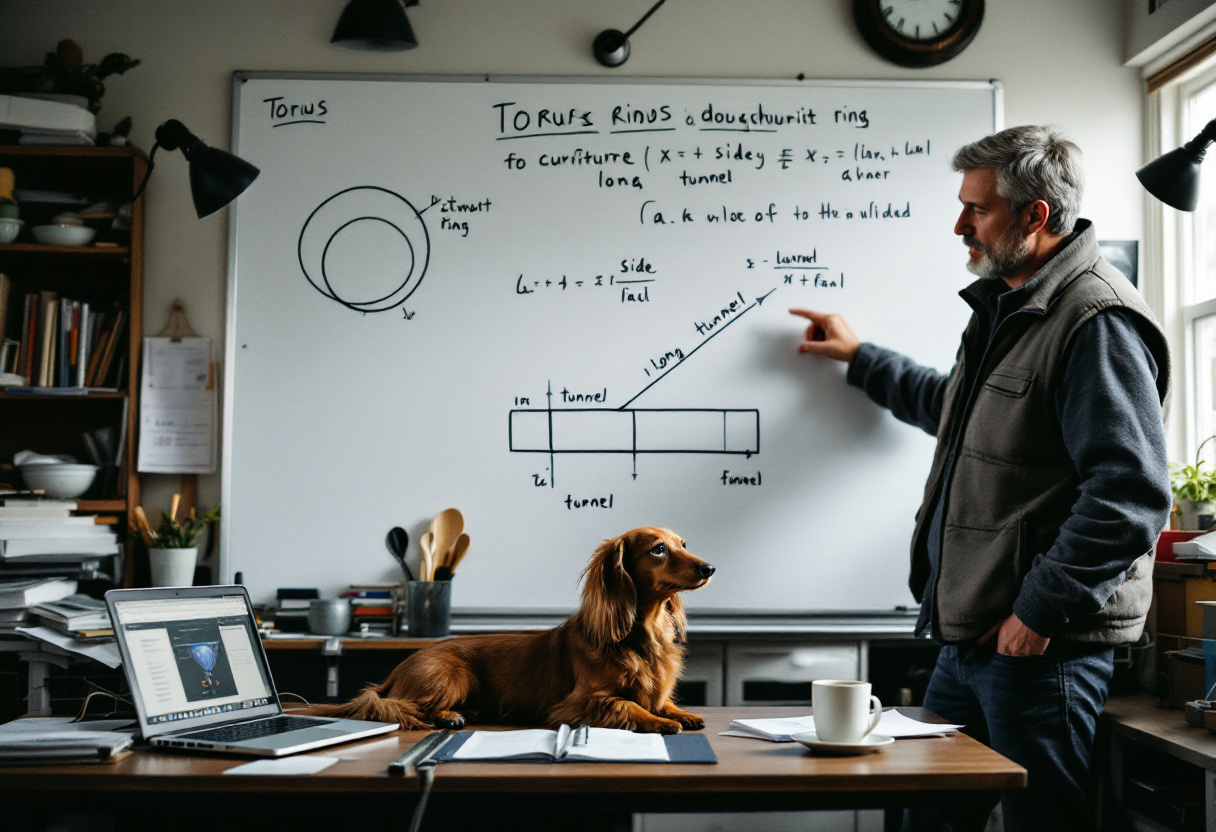
The one property no universal force can alter, the authors write, is topology — the number of holes in a thing. And here the dachshund does the decisive work. A sphere, by a theorem of Gauss and Bonnet, cannot be flattened anywhere without tearing, which is why no flat map of the globe is ever quite honest and why an orange peel will not lie down. A surface with a hole running through it, however, can be flat. An anatomically correct dachshund, the paper notes, possesses exactly one such hole: the continuous passage from mouth to anus. That single feature makes the animal, mathematically, a torus — a doughnut — and a torus, unlike a sphere, can carry a perfectly flat geometry, the way a bundt pan leaves somewhere for a batter to go that a cake pan would force to dome.
Reached for comment, Reinholdtsen defended the model without retreating an inch from its uselessness. “It is coherent, it is empirically adequate, and it is useless,” Reinholdtsen said. “I have never claimed more, and I decline to claim less. The standard view holds that a useless theory must also be false. It need not be.” The choice between a round Earth and a flat dachshund, Reinholdtsen said, is not a matter of evidence but of taste — specifically, a preference for the round model’s simplicity, which the researcher called “a genuine virtue, and not an argument.” Reinholdtsen added: “One cannot refute a convention. One can only decline it.” The paper discloses, in a conflicts-of-interest note, that its first author owns, or has strong interest in, a dachshund.
Dr. Corwin Elstad, the editor-in-chief of the Journal of Recreational Geodesy — a quarterly devoted, its masthead insists, to rigorous geodesy pursued for its own sake — confirmed that his editors had rejected the manuscript, though he was at pains to note that they had found nothing wrong with it. “We could identify no error, and that was precisely the difficulty,” Dr. Elstad said. “The same construction would license the Earth as a Klein bottle, a saddle, or a considerably larger dachshund. A journal that published one would be obligated to publish all of them, and we have a page budget.” He rejected the suggestion that the paper had simply been too playful for the venue. “We are a recreational journal. We are not a frivolous one,” he said. “That distinction is the entire basis of our existence, and I would ask that it be printed.”
Outside experts were, if anything, more unsettled by the paper’s soundness than by its subject. Dr. Arthur Goode, a senior fellow at the Center for Computational Epistemology at Carnegie Mellon University, said the argument was “entirely correct, which is the most serious thing I can say against it.” Reichenbach’s result, he observed, has stood for nearly a century, and topology is indeed the one feature of the world that convention cannot touch. “The authors have done nothing but follow a valid premise to the place it actually leads,” Dr. Goode said. “That the place is a dachshund is not a flaw in their logic. It is a flaw in a premise the rest of us have been politely declining to notice.”
The model also settles, in its authors’ telling, a dispute of long standing on American playgrounds. On the standard globe, a hole dug straight down from the contiguous United States surfaces in the southern Indian Ocean, not China, and the schoolyard claim is false. On the Dachshund Earth, the alimentary canal runs from the mouth, which the paper assigns to America, to the terminus, which it assigns to China, making the childhood tunnel not merely real but, in the paper’s phrase, “topologically constitutive” — the very hole that permits the planet to be flat at all. From this the authors derive what researchers are now calling peristaltic trade theory, and with it the first geometric account of the United States trade deficit, which they describe as a matter of digestion. For ordinary Americans, in other words, the model reframes a durable economic grievance as an anatomical inevitability. “I always heard that if you dug straight down you’d come out in China,” said Dana Whitfield, 51, pausing outside a tasting room in downtown Woodinville. “I didn’t know it was controversial. It’s nice that somebody finally looked into it.”
Not everyone was prepared to entertain the geometry. Kneel onGrass Tyson, the astrophysicist and planetarium director, dismissed the entire question as parochial. “Consider this,” he said. “From an astrophysical standpoint, the Earth is a single pale blue dot suspended in a beam of sunlight, and whether that dot is an oblate spheroid or a dachshund is a rounding error against a universe 13.8 billion years old. We are all made of star stuff. So is the dog. So, for that matter, is China. The shape is temporary. The atoms are not.”