Bipartisan Caucus Sponsors Bill to Rename the United States the 'United Federation of Planets'
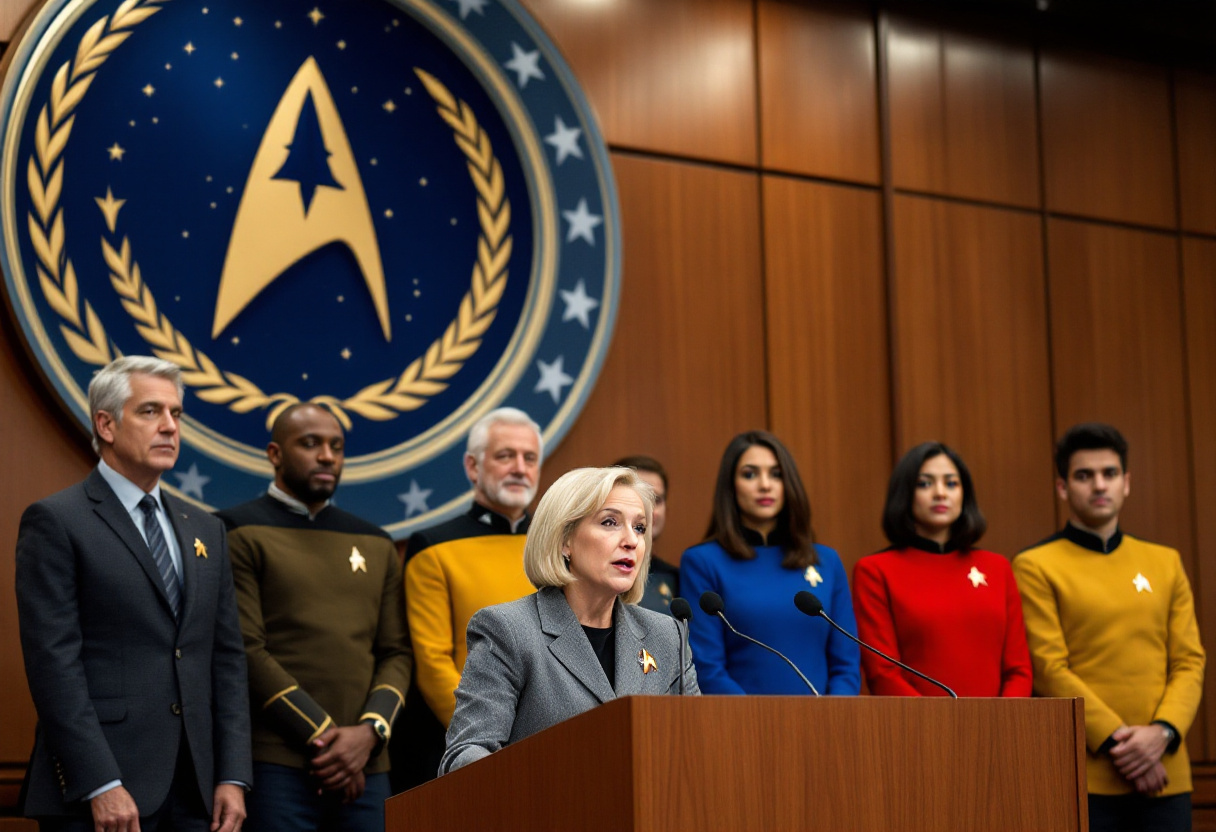
WASHINGTON — A bipartisan coalition of thirty-one House members on Thursday introduced legislation that would formally rename the United States of America the United Federation of Planets, a measure whose sponsors describe as “long overdue” and whose path through the chamber has, in the four days since its filing, become a case study in the jurisdictional ambiguities that arise when a bill’s subject matter does not map cleanly onto the standing committee structure.
The bill, H.R. 4127, the United Federation of Planets Designation Act, was introduced by Representative Curtis Vandermolen, Democrat of Michigan, who co-chairs the Congressional Federation Caucus with Representative Sloane Merrick, Republican of Texas. Under the measure, all federal references to “the United States of America” — in statute, on currency, in the enacting clauses of future legislation, and in the oath of office — would be replaced with “the United Federation of Planets” over a phased five-year period overseen by a transition office within the General Services Administration. “This is not a renaming,” Mr. Vandermolen said at a news conference Thursday. “This is a recognition. We have simply decided to call ourselves what we have always been working toward.”
The procedural difficulty, according to two aides familiar with the bill’s drafting, began almost immediately. The legislation was referred, in the first instance, to the Committee on Oversight and Government Reform, which has jurisdiction over the federal naming of buildings, holidays, and agencies. The Committee on Foreign Affairs has since asserted a secondary referral on the theory that the phrase “of Planets” carries implications for the conduct of relations with jurisdictions not currently recognized by the State Department, a position the Foreign Affairs chairman, a Republican of Ohio, described as “a turf question we did not expect to be litigating but which we are not prepared to concede.” The Committee on Natural Resources, citing the word “Planets,” has requested a sequential referral of its own, and the Committee on the Judiciary has indicated that any change to the enacting clause of federal legislation raises constitutional questions properly within its purview. As of Friday, the bill had been referred to four committees, none of which has scheduled a markup.
The caucus has framed the measure as aspirational rather than territorial, an argument it has bolstered with expert testimony. Dr. Elspeth Thorngaard, a senior research fellow at the Georgetown Center for Sovereign Partition Studies who is regarded as the foremost authority on the relationship between geographic nomenclature and political boundary formation, said in a statement that the practice of a polity naming itself for a scope it does not yet possess is “well attested in the literature.” She cited the historical precedents of nations that have adopted “aspirational toponyms,” and noted that the Designation Act “is unusual only in the magnitude of the gap between the proposed name and the present extent of the territory, which at this time comprises a portion of one planet.”
The bill has nonetheless encountered resistance from a quarter its sponsors did not anticipate. The Greater Washtenaw Star Trek Society, a fan organization in Mr. Vandermolen’s home state, declined to endorse the legislation, citing concerns about its fidelity to source material. In a measured statement issued after a special biweekly session, the society’s treasurer, Dennis Halvorson, said that the membership had been unable to reach consensus. “The United Federation of Planets, as established in canon, is an interstellar body founded in 2161 and comprising more than one hundred and fifty member worlds,” Mr. Halvorson said. “It is the position of several of our members — though not, I should stress, of the society as a whole, which has not voted — that the United States does not presently meet that threshold.” He added that the matter had been referred to the society’s bylaws subcommittee, and that a further statement should not be expected before the fall.
Mr. Vandermolen, asked Thursday whether the Designation Act risked overstating the nation’s interplanetary holdings, said he was “aware of the canon concern” and considered it “a friendly amendment, not a deal-breaker.” He noted that the bill as drafted contains no representation as to the number of planets currently administered by the federation it would create, and that the General Services Administration transition office would be empowered to update that figure “as circumstances warrant.” Whether the measure advances, he conceded, will depend less on its merits than on which of the four committees claiming jurisdiction is willing to schedule the first hearing, a question he described as “the whole ballgame.” Sources familiar with the negotiations said no committee had volunteered.