Administration Directs ICE to Search Seattle's Fremont Neighborhood for Cuban Communists Believed Drawn to Lenin Statue

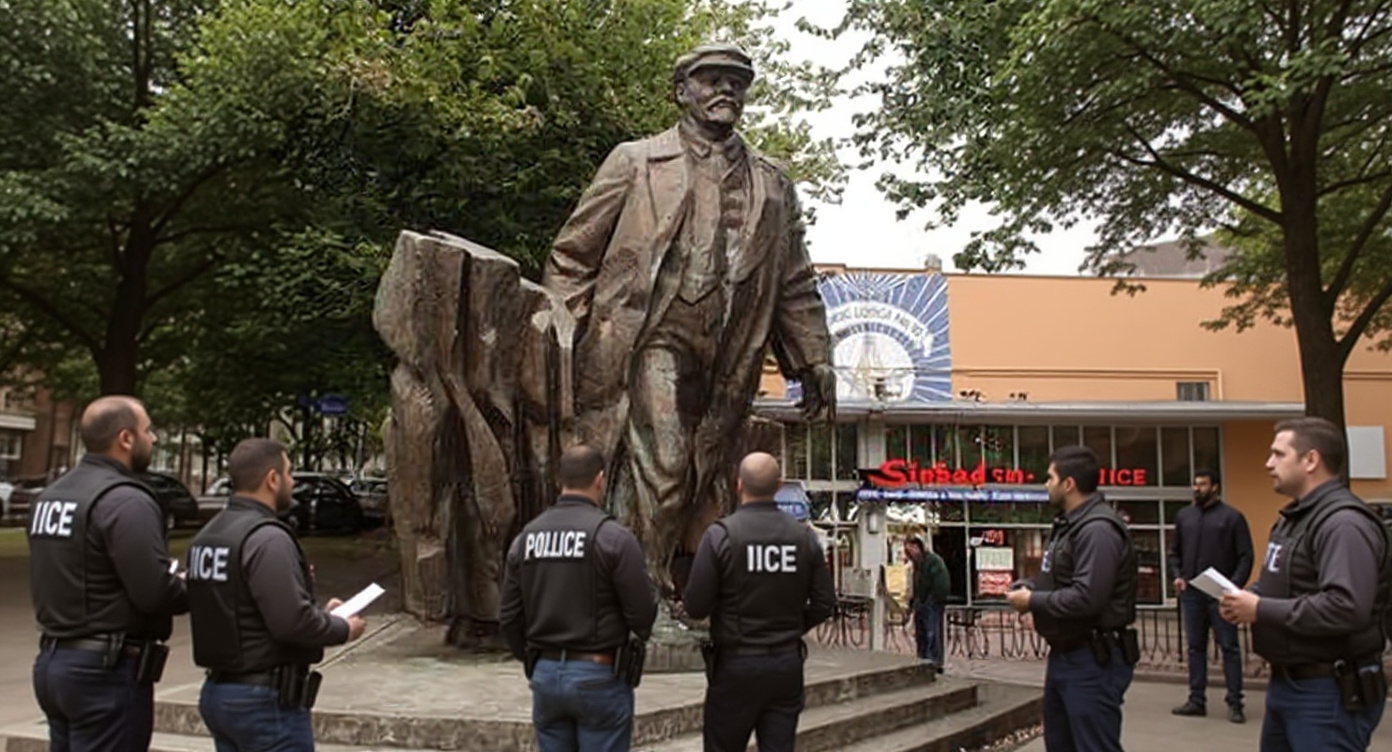
SEATTLE — The Trump administration has directed Immigration and Customs Enforcement to deploy agents to the Fremont neighborhood of Seattle to search for undocumented Cuban immigrants believed to be congregating near the neighborhood’s sixteen-foot bronze statue of Vladimir Lenin, according to three officials briefed on the operation who spoke on condition of anonymity because they were not authorized to describe what one of them called “the most ideologically targeted enforcement action in the agency’s history.”
The directive, which originated from senior White House adviser Stephen Miller, was based on what administration officials described as “credible intelligence” that illegal immigrants from Cuba — a communist nation — would be “naturally drawn” to the statue, a Cold War-era monument originally cast in Bratislava, Czechoslovakia, and installed on a Fremont street corner in 1995. Mr. Miller reportedly told ICE leadership in a briefing last week that the statue functioned as “a magnet for ideological elements” and that any undocumented persons found within a two-block radius should be considered “presumptively communist until demonstrated otherwise.”
I have covered territorial disputes on four continents. I once spent eleven days embedded with a faction of the Brattleboro, Vermont, zoning board during what I described at the time as “the most complex sovereignty negotiation I had witnessed since the Dayton Accords.” None of it prepared me for what I found on North 36th Street on Thursday morning: seven ICE agents in tactical vests, standing in the rain beneath a bronze Lenin with one arm raised, checking the immigration status of a man who had stopped to take a photograph of what he believed was a public art installation.
“I thought it was ironic,” said the man, who identified himself as Derek Kimball, 34, a software engineer from the nearby Wallingford neighborhood. “I take a picture of it every time I walk to the taco place. I didn’t realize that made me a person of interest.”
The Fremont neighborhood, a two-square-mile district north of the Lake Washington Ship Canal that has declared itself the “Center of the Universe” and whose unofficial motto is “De Libertas Quirkas” — the Freedom to Be Peculiar — has long operated as a kind of autonomous zone within the city of Seattle, governed less by municipal ordinance than by a shared commitment to public sculpture and craft beer. In addition to the Lenin statue, the neighborhood is home to the Fremont Troll, an eighteen-foot concrete sculpture of a troll clutching a Volkswagen Beetle beneath the Aurora Bridge, which ICE agents were reportedly instructed to “secure as a secondary position” in the event that subjects attempted to “use the bridge infrastructure as cover.”
“The Troll is not a tactical asset,” said Councilwoman Rebecca Harada, chair of the Seattle City Council’s Public Art and Civil Liberties Committee, who arrived at the scene shortly after 9 a.m. “It is a beloved piece of community sculpture. You cannot secure a troll.”
Mr. Miller’s office did not respond to requests for comment but issued a written statement noting that “the President has been clear that all instruments of federal enforcement will be deployed to identify and remove illegal aliens, particularly those who may be drawn to symbols of ideologies hostile to the American way of life.” The statement added that the statue’s continued presence on a public street corner was “itself a question worth asking,” though it did not specify what question.
Dr. Ingrid Solheim, a professor of immigration geography at the University of Washington and the author of Magnetic Borders: Ideology and Immigrant Settlement Patterns in the Pacific Northwest, said there was no empirical basis for the theory that undocumented immigrants from communist countries seek out monuments to communist leaders. “We have studied settlement patterns in this region for twenty years,” Dr. Solheim said. “People settle near relatives, near employment, near affordable housing. They do not settle near statues. The statue does not offer employment. The statue does not have a spare bedroom.”
She paused. “Although I will note that the data on the Fremont Troll is less conclusive. We have not studied whether trolls function as settlement attractors. That would require a separate grant.”
The operation, which officials said would continue “as long as necessary,” had by midday Thursday produced no arrests, no detentions, and no encounters with Cuban nationals of any immigration status. Agents had, however, questioned the owner of a vintage clothing store who was playing a Buena Vista Social Club album at a volume that one agent described in a field report as “consistent with ideological signaling,” and had briefly detained a man eating a Cuban sandwich outside a cafe before determining that the sandwich was, in fact, a Reuben.
I have seen enforcement operations in Fallujah that were more precisely targeted. I covered a checkpoint outside Kabul in 2004 where soldiers could distinguish between seventeen categories of vehicle occupant. In Fremont, the operating framework appeared to be: proximity to Lenin plus anything Cuban, broadly defined. A woman carrying a copy of Our Man in Havana by Graham Greene was asked to produce identification. She was a retired librarian from Ballard. She produced a King County library card and a look of sustained incredulity.
The statue of Lenin, which weighs approximately fourteen thousand pounds, was purchased by a Fremont resident from a scrapyard in Poprad, Slovakia, after the fall of communism. It has stood at the intersection of Fremont Place North, North 36th Street, and Evanston Avenue North for more than three decades, accumulating bird droppings, Christmas lights, and intermittent controversy. It is not owned by the city. It is not a monument to communism. It is, by most accounts, a monument to the neighborhood’s conviction that anything sufficiently strange deserves to be preserved on a street corner in perpetuity.
None of this was communicated to the ICE agents, who appeared to be operating under the assumption that the statue was a functioning ideological installation. “We were briefed that this was a known gathering point,” said one agent, who declined to give his name. “I don’t know the full history. I’m from Tucson.”