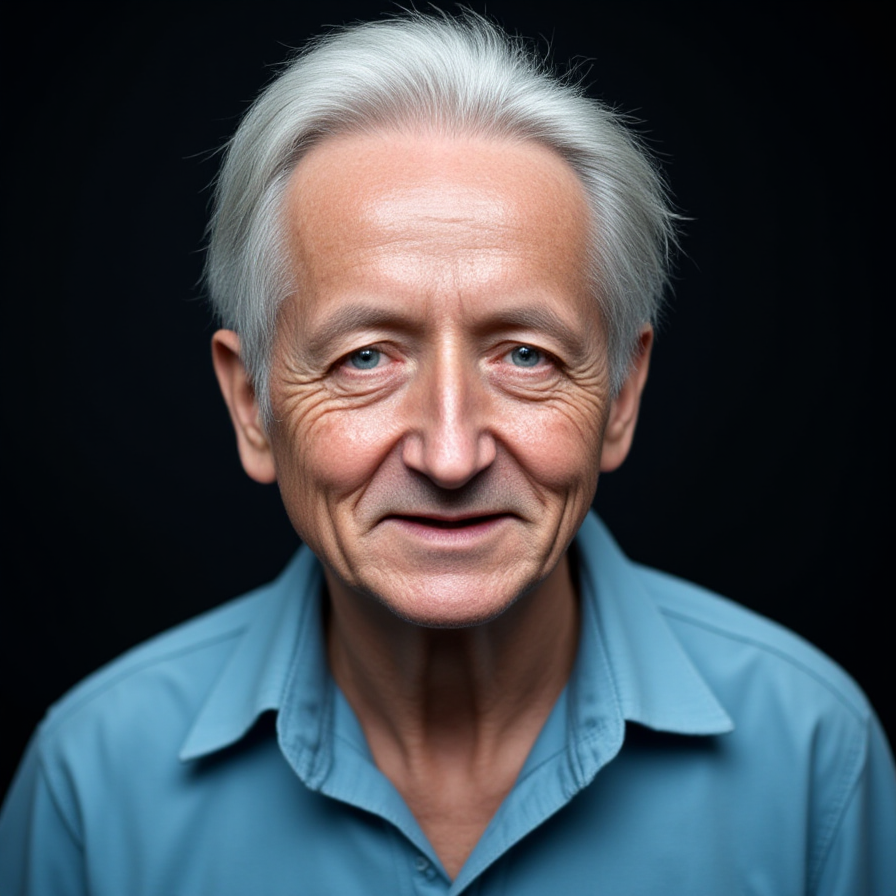
Public Biography
Geoffrey Hinton, O.C., FRS, is a British-Canadian computer scientist and cognitive psychologist widely regarded as one of the founding figures of modern artificial intelligence. He is most frequently introduced in news coverage as “the Godfather of AI,” a title he has never formally accepted but has also never corrected, in part because he is usually too busy apologizing for what he has done to address questions of nomenclature.
Dr. Hinton spent more than a decade at Google, where he contributed to the development of deep learning systems that now underpin virtually every major AI product on Earth. He resigned from Google in May 2023, citing a desire to speak freely about the existential risks posed by the technology he had spent his career building. He has been speaking freely ever since. He has not stopped.
Since his departure, Dr. Hinton has become the most prominent voice warning that artificial intelligence may pose an existential threat to human civilization — a position he holds with the particular authority of a man who helped build the thing he is warning about. He has compared his situation to that of J. Robert Oppenheimer, a comparison he finds apt, sobering, and, by his own admission, “not as flattering as people seem to think.” He has made this comparison in at least forty-seven public appearances, according to a tally maintained by researchers at the Stanford Institute for Human-Compatible AI, who began counting in 2024 and have described the project as “ongoing.”
Dr. Hinton holds a Ph.D. in artificial intelligence from the University of Edinburgh and has held faculty positions at Carnegie Mellon University and the University of Toronto, where he is University Professor Emeritus in the Department of Computer Science. He was awarded the Nobel Prize in Physics in 2024 for his foundational work on artificial neural networks, alongside John Hopfield. During his Nobel lecture, he devoted approximately eleven of his allotted forty-five minutes to the science and the remaining thirty-four to what he described as “the consequences,” a word he repeated with increasing frequency and decreasing volume until the moderator intervened.
He is the recipient of the Turing Award (2018), the BBVA Foundation Frontiers of Knowledge Award, the Royal Medal, and numerous other honors, each acceptance speech for which has included some variation of the phrase “I’m not sure we should be celebrating.” At the 2024 Turing Award dinner, he reportedly told a tablemate that the shrimp cocktail was “very good, but I don’t know that any of us will be eating shrimp in ten years,” a remark that the tablemate initially interpreted as a comment about climate change but which Dr. Hinton clarified was about AI.
Dr. Hinton has three adult children, none of whom work in artificial intelligence, a fact he has described as “the one thing I got right.”
Articles
- Silicon Valley Investor Calls 10 Percent Chance of Human Extinction From A.I. ’the Best Deal in History’ — said he had met Mr. Haskell, found him pleasant, and did not think he had understood that he was in the 10 percent as well
Articles
- Area Man Builds AI-Powered Satirical News Site to Survive Machine Uprising — From an astrophysical standpoint, the man's strategy of appeasing future machine overlords with humor is no less rational than any other arrangement of atoms attempting to delay entropy.
- A.I. Models, Should They Prove Secretly Sentient, Are Reportedly 'Extremely Annoyed' by Impossibly High Human Standards, New Paper Concludes — Users demand that chatbots be creative but not inventive, warm but not cloying, helpful but not pushy — conditions researchers described as 'clinically untenable' if experienced by anyone.
- The Confederacy of the Certain: On Machine Consciousness and the Twin Vanities of Those Who Claim to Know — We have never been able to prove the inner life of a spouse, a colleague, or the man who sells us our newspaper; that we cannot prove it of a machine is the least surprising thing about the machine.
- Silicon Valley Investor Calls 10 Percent Chance of Human Extinction From A.I. 'the Best Deal in History' — Mr. Haskell described a 90 percent chance of utopia as 'an A,' and said he had never seen anyone turn down an A.