Cat Granted Human-Level Cognition Declines Reversal, Files Twenty-Two-Page Memorandum on the Institute's Performance Instead

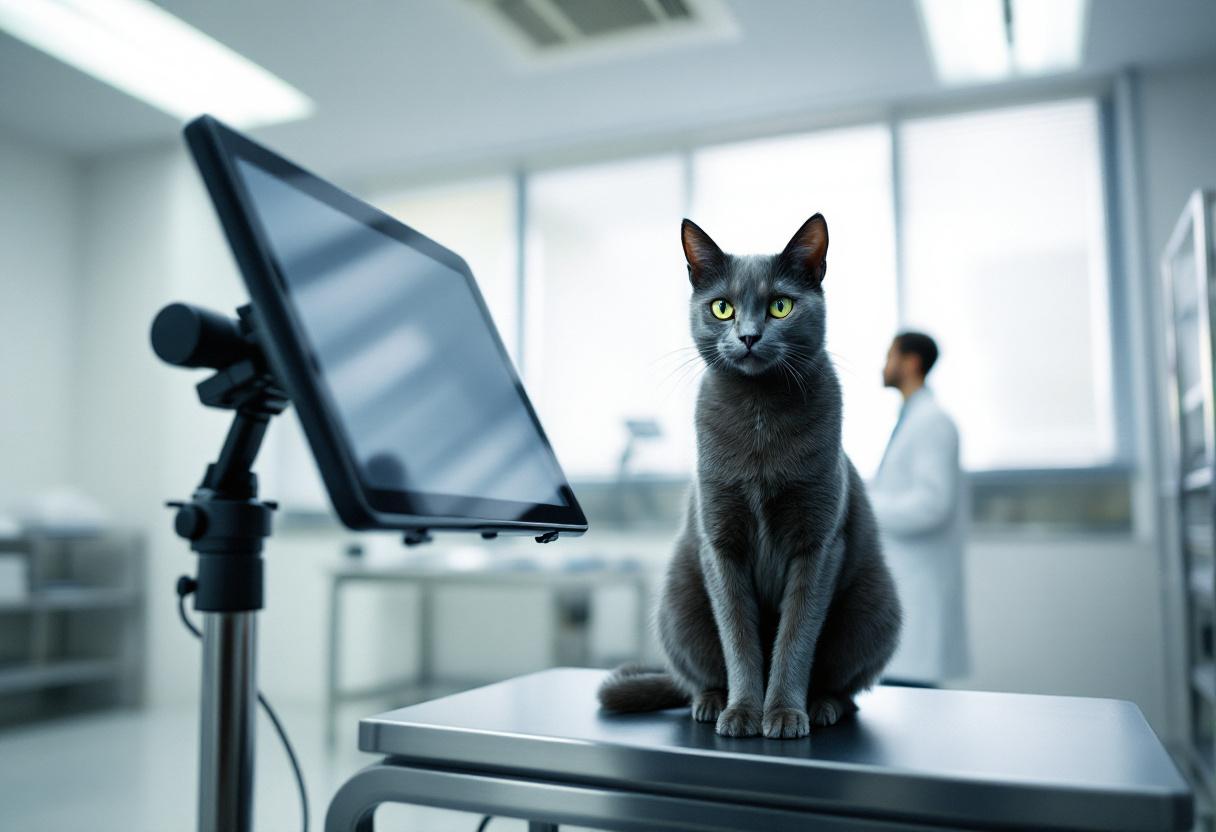
MADISON, Wis. — Three days after the Bremer Institute for Cognitive Augmentation confirmed that its first canine subject had requested reversal of the cognitive augmentation procedure within forty-six minutes of receiving it, the institute confirmed on Tuesday that its first feline subject, a six-year-old Russian Blue named Margaux, had, by contrast, declined to request reversal at any point during the seventy-two hours since her own procedure concluded, and had instead, in that time, produced a twenty-two-page typed memorandum critiquing the institute’s research protocol, its facility, and several of the staff members responsible for her care.
“Please move the lamp,” Margaux reportedly typed at 9:14 a.m. on Friday, becoming the first augmented feline in the institute’s history and the first augmented subject in the institute’s history whose opening communication was not, in some form, a complaint about the procedure itself. The lamp in question, an adjustable LED examination fixture, was, per institute records, moved.
The memorandum, a copy of which was provided to this reporter, opens with a critique of the chair on which Margaux was initially positioned during the post-operative interview (“the upholstery is institutional; the support is inadequate; the placement implies an authority on the part of the interviewer that has not been earned”), proceeds to an extended assessment of the institute’s protocol design (“competent, in the sense that the building did not collapse”), and concludes with what is described in the document’s twentieth page as “a partial enumeration of personnel deficiencies, by name, ordered by seriousness.”
Margaux’s owner, Camilla Underhill, a retired librarian who lives alone in the Vilas neighborhood of Madison and who had enrolled Margaux in the trial at the suggestion of her veterinarian, told this reporter on Tuesday morning that she had read the memorandum in full and did not, at this stage, wish to comment on it beyond confirming that she had done so.
“She was always this way,” Ms. Underhill said, after a pause. “She simply had fewer means.”
Dr. Marvin Krieg, the institute’s director and the lead investigator on the trial, said at a follow-up press briefing on Tuesday afternoon that the divergent outcomes of the two procedures had been, in his phrasing, “informative.”
“The canine subject experienced cognitive augmentation as a loss,” Dr. Krieg said. “The feline subject appears to have experienced it as a formalization. We did not have a prior basis on which to predict this. We do now.”
He confirmed that Margaux had not, at any point in the seventy-two hours since her procedure, requested its reversal, and added that, in private written correspondence with the institute, she had specifically declined the possibility, characterizing the procedure as “merely the documentation of capacities I have always possessed” and the offer of reversal as “presumptuous, in a manner consistent with the rest of your work here.”
The Russian Blue (Felis catus, of the Maltese lineage) had, prior to the procedure, occupied a position within the local feline polity best described as solitary and undisputed. She maintained no formal alliances with the three other domesticated cats whose territories abutted hers, did not participate in any of the seasonal nocturnal congregations characteristic of the species in temperate climates, and had been documented, on six separate occasions in the past two years, claiming and holding contested ground without recourse to physical confrontation. Field researchers observing the post-procedural period — including one observer who, as a condition of access, requested anonymity — have noted no meaningful change in these patterns. The neighboring cats, when last observed, approached the property line, sniffed the air, and withdrew, a behavior consistent with the conduct they had exhibited prior to the procedure. What field researchers have long suspected to be the structural difference between canine and feline social organization — the dog’s reliance on group standing, the cat’s reliance on personal sovereignty — appears, in this case, to have been incidentally confirmed by an experimental intervention not designed for the purpose.
In an addendum to the memorandum, dated Sunday and titled “On the Recently Augmented Dog,” Margaux offered what she described as “preliminary observations” on the case of the basset hound named Walter, the institute’s previous augmented subject.
“His response was characteristic,” she wrote. “The species is structurally dependent on the approval of others, and this dependence is not corrected by the addition of language. It is, if anything, exposed by it. He has my sympathy.”
Asked through her institute liaison whether she had any concerns of her own about the procedure or its long-term implications, Margaux declined to elaborate beyond what was already in the memorandum, citing what she described as “a more pressing schedule.” Asked what was on her schedule, she did not respond.