Diagnostic Manual Adds 'Patriotic Derealization Syndrome' as Patients Increasingly Report 'the America I Love Does Not Exist'

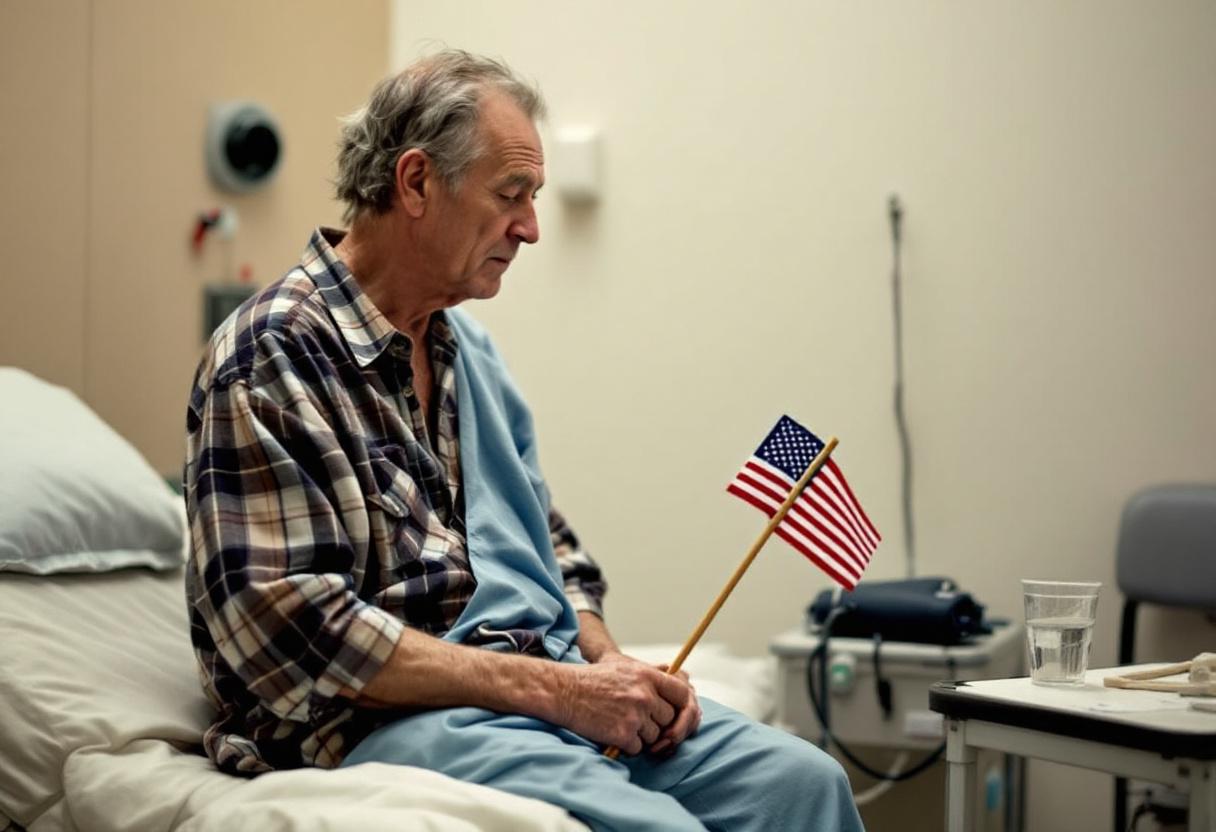
BETHESDA, Md. — A 67-year-old retired postal carrier from Wausau, Wis., presented at a local emergency department in late March with what attending physicians initially logged as a possible stroke. The patient, Robert Pavel, was alert and oriented. He could correctly identify the day of the week, name the current president, and recite his home address. He could not, however, locate the country he had spent his life in. “It’s just gone,” he reportedly told the resident on call. “It was here last Tuesday.”
Mr. Pavel’s presentation, according to a paper published this month in The American Journal of Psychiatry, is one of more than 1.4 million broadly similar cases recorded at U.S. hospitals over the past eighteen months — a surge that has prompted the American Psychiatric Association to add a new diagnostic category to the latest revision of its Diagnostic and Statistical Manual of Mental Disorders. The condition, designated 309.94, is what researchers are now calling Patriotic Derealization Syndrome, or P.D.S.
The defining feature of P.D.S., according to the new criteria, is “an acute, persistent, and unshakable conviction that the country the patient loves no longer exists, in the absence of any cognitive impairment that would otherwise account for the belief.” Patients can name the country. They can locate it on a map. What they report — what is reportedly consistent across the literature, from Bangor to Bakersfield — is the feeling that the country they recognize is, like a casserole prepared from a familiar recipe with one wrong ingredient, no longer the country they grew up in.
“The brain scan is normal. The bloodwork is normal. The patient is, by every neurological measure, fine,” said Dr. Constance Halbritter, the founding director of the Bethesda Center for Civic Affective Disorders, in an interview at her clinic last week. “What our patients describe is a kind of architectural absence. They can see the building. They tell us the building is not there. We have not, in psychiatry, had a term for this until now.”
The DSM-5-TR-2 criteria are unusually specific about the precipitating stimulus. To meet diagnostic threshold, episodes must be “temporally linked to exposure, by media or proximity, to a single sitting executive officeholder,” a phrasing several reviewers had argued was insufficiently clinical but which the working group ultimately retained on the grounds that the data, in their words, “do not support a more general formulation.” All 1.4 million documented cases have followed exposure to President Donald Trump. The working group did not consider this a political finding. It considered it a methodological one.
Treatment options remain limited. Cognitive behavioral therapy has shown some efficacy in mild cases — patients who experience distress at the sound of the national anthem but can still finish singing it. Severe cases, in which patients can no longer recognize the American flag without an elevated heart rate, or who report being unable to “place” the country on a map of itself, are being referred to a federally funded inpatient program in Bethesda, where the average stay is fourteen days. According to internal program data, roughly 60 percent of patients leave with their conviction unchanged. “The conviction is not, strictly, treatable,” Dr. Halbritter said. “What we treat is the suffering around the conviction.”
Not all clinicians accept the diagnosis. Dr. Reginald Fortenberry, a psychiatrist at the University of Chicago and the most vocal critic of the new entry, has argued that P.D.S. is not a disorder but a “cognitively appropriate response to verifiable change,” and that pathologizing the experience risks delegitimizing what may, in his view, be a coherent assessment of the world. “If the patient says the country has changed, and the country has demonstrably changed, the clinical question is not why he believes it,” Dr. Fortenberry said at a recent panel at Northwestern’s Feinberg School of Medicine. “The clinical question is what we are doing calling it a disorder.” Dr. Halbritter has acknowledged the objection, characterizing it, in remarks colleagues have described as professionally charitable, as “an active area of inquiry.”
For ordinary Americans, the practical implications are unclear. The DSM-5-TR-2 entry advises clinicians to ask, during routine intake, whether the patient has experienced “a sudden or persistent feeling that the country they love is no longer there.” A standardized screening instrument, the Patriotic Derealization Inventory (PDI-12), is being piloted at Veterans Affairs facilities this summer. A pamphlet prepared for general distribution by the National Institute of Mental Health includes the line, “If you are reading this and the line means something to you, please continue.”
Mr. Pavel was discharged after three days of observation. He was given a follow-up appointment, a prescription for low-dose sertraline, and a pamphlet titled “When the Country You Loved Feels Different: A Guide for You and Your Family.” He has not, as of last week, opened it. “I’m not going to read a pamphlet about my own country,” he said. “I just want to know where it went.”