The Elephant in the Elephant's Room: On the Conservative Movement's Disciplined Refusal to Discuss the Awfulness of Donald Trump

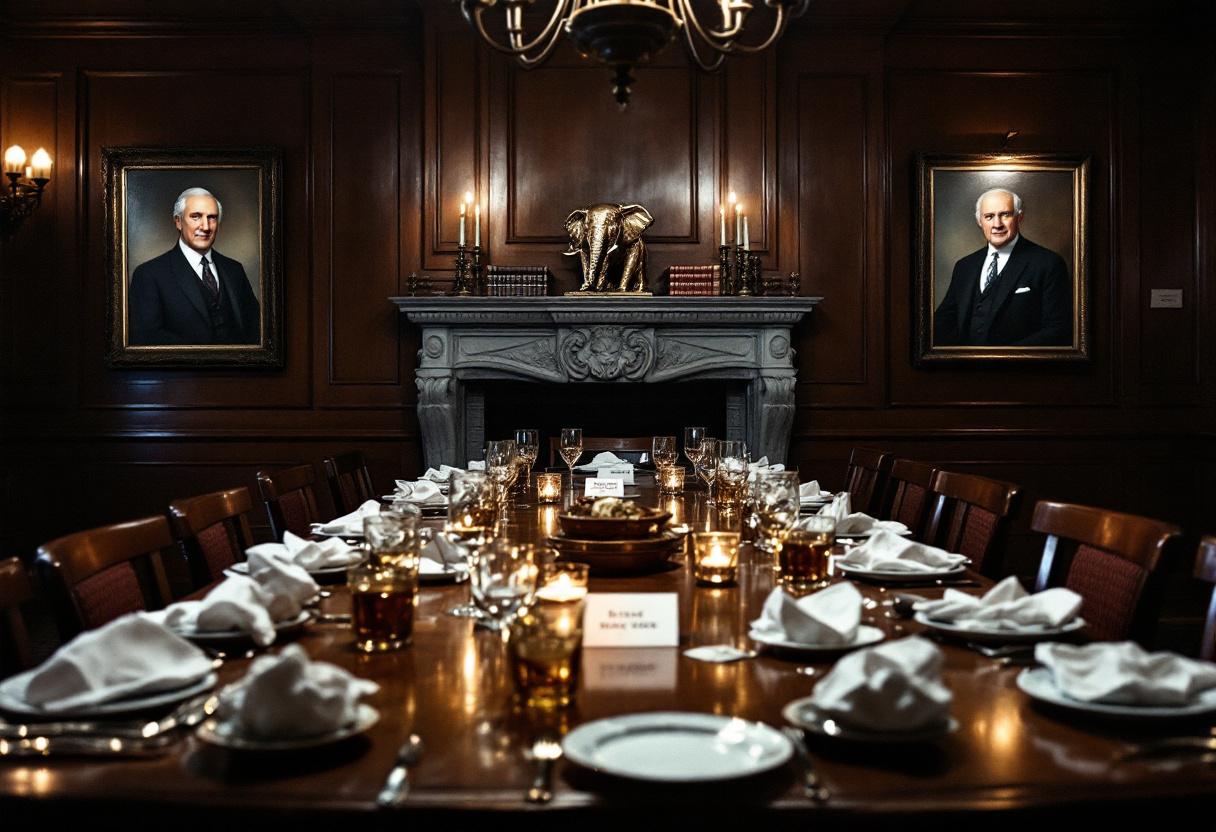
WASHINGTON — The first thing a sympathetic visitor to any present-day gathering of the American conservative movement will notice — once one has navigated the lapel pins, the bourbon poured at a temperature for which there is no defense, and the slightly forced triumphalism that persists even in those wings of the project that, by any honest reckoning, are presiding over rubble — is the silence. It is not a literal silence. The room is in fact deafening with talk. Talk of Madison, talk of Burke, talk of the long inheritance running from Cicero through the Federalist Papers to the bow tie of one’s host. What it is not talk of, and what it is on no account ever to become talk of, is the man whose name is at this very moment on every yard sign, every fundraiser invitation, and every executive order issuing from the building three blocks to the south. There exists, in this room and in every room like it, an elephant; and the elephant, as it happens, is a Republican.
I have spent the better part of three decades in the company of these people, by inclination as much as by assignment. They are, on the whole, more interesting than their progressive counterparts and considerably better read than their populist heirs. They are also, at the moment, engaged in a feat of collective inattention so disciplined, so architecturally complete, that one is moved to admire it as one admires a particularly elaborate piece of evasive cabinetry. Donald Trump is many things, and the conservative mind — the genuine, considered conservative mind, the mind that produced Jorge Will and the late William F. Buckley and the various ghostly subscribers to Commentary who still receive it in print — knows perfectly well what he is. He is vulgar. He is venal. He is unread, unmoored, and unbothered by either condition. He is contemptuous of the institutions whose preservation has been, for half a century, the stated and even credible purpose of American conservatism, and his contempt for them is not strategic but constitutional — he does not know what they are for, and he resents being asked. He is, to use the most precise word in the English language for his particular variety of public ruin, awful. And he is, at this point, the entire movement’s tenant, landlord, and structural engineer. The lease is permanent. The building is on fire.
Consider, for a moment, what is required of a serious person to notice such a thing. It is not, as the more excitable progressive commentators imagine, a matter of moral courage or special insight. The evidence is on the front page. It has been on the front page for nine consecutive years. One does not need to consult Aquinas, or Tocqueville, or even one’s own conscience — one needs only to read the wire copy with a minimal commitment to the meaning of words. The man is on tape. The man is in the indictments. The man has, in his own voice and in his own interest, narrated the case against himself with the tireless industry of a memoirist. To not see Donald Trump for what he is, in the year of our Lord 2026, requires a kind of effort. It requires the willed averting of the gaze, the rotation of the body in the room, the careful redirection of any conversation that threatens to land on the subject. And this effort, dear reader, is precisely what is being made — by men and women who, in any other century, would have made it the defining business of their professional lives to say so.
It will not do to pretend that the silence is principled. I have heard the apologies, and they are unworthy of the apologists. He has appointed good judges. So have worse men. He has cut the corporate tax rate. So could a child with a calculator. The alternative is the progressive left. The progressive left, whatever one’s view of its excesses, has not yet attempted to overturn the result of a national election by the encouragement of a mob, the threatening of a vice president, and the issuance, after the fact, of pardons to the rioters who beat policemen with flagpoles bearing the very flag of the country whose constitutional order they were attempting to disrupt. I am open, as a matter of intellectual courtesy, to the proposition that some hypothetical Sanders administration might, in some hypothetical universe, have done something analogous. I am not open to the proposition that this hypothesis confers a usable equivalence in the present.
A senior fellow at one of this city’s better-known conservative think tanks — a gentleman whose work on the separation of powers has been cited by three sitting Supreme Court justices and who consented to speak only on the condition that his name be left, in his own phrase, “where it does no further damage” — explained the position with admirable candor over a glass of something that was, mercifully, not bourbon. “We don’t talk about it,” he said. “We talk around it. There is a difference, and the difference is what I get paid to maintain.” It was, I confess, the most honest sentence I had heard at a Washington dinner in some time, and I commend it to the historical record.
It is worth noting that no such silence was ever demanded of these same minds when their target was a Democrat. When Bill Clinton lied about a stained dress, Mr. Will produced a column of such fastidious moral censoriousness that one half-expected him to call for Tarquinius Superbus to be exhumed and tried again, this time properly. “Character, in a chief executive,” Mr. Will wrote on that occasion, “is not a private matter but the constitutional substance of the office, and a republic which forgets the distinction has begun the slow, semicolonless slide toward the rule of appetite.” It was a sentence so beautifully constructed that one could forgive the author almost anything — except, perhaps, the failure to apply its plain meaning to the current incumbent, against whom it could be redeployed without the alteration of a single subordinate clause. When Barack Obama wore a tan suit, the same intellectual milieu spent forty-eight hours debating the constitutional implications. When Joe Biden — a man whose chief offense against the republic was to be visibly older than the republic preferred — confused the names of two foreign capitals on a Tuesday, the editorial pages produced enough disapproving prose to insulate a small house. These men were held to the standard. The current incumbent is held to the wallpaper.
And it is here that the comparison sharpens to a point that one would prefer not to draw, but cannot in honesty avoid. There is a French phrase — la trahison des clercs, the treason of the clerks, coined by Julien Benda in 1927 to describe the readiness of the European intellectual class of his day to subordinate their commitments to the parties and passions of the moment — which has acquired, by the year 2026, an unwelcome new tenant. It is not an exact fit. The American conservative intellectual has not endorsed atrocity; he has merely declined to name it. He has not collaborated; he has, more elegantly, abstained from the conversation that would oblige him to. He has not signed the loyalty oath; he has simply, when asked, observed that the question is more complicated than it appears, that the alternative is worse, that the moment is not the moment, that the column, regrettably, is already filed. This is not collaboration in the historical sense. It is something less culpable and, in another way, more depressing: it is the long, civilized, bow-tied surrender of the discipline that was supposed to be the conservative movement’s reason for existing — the discipline of looking at a fact and refusing, on grounds of taste alone, to call it something else.
It is fashionable, in those few corners of the right where the topic is permitted, to argue that Mr. Trump is a temporary aberration, a kind of historical wave one waits out by closing the shutters and refusing to comment on the weather. This is, to put it gently, fatuous. The man is not the wave. He is the new shoreline. The party that has nominated him three times, the donor class that funds him, the legal apparatus that protects him, the media ecology that mythologizes him, and the intellectual class that — through the simple expedient of agreeing not to notice — confers upon him the dignified silence that consensus normally reserves for the dead, are not weather. They are climate. And one does not wait out a climate. One either names it, and lives, or fails to name it, and discovers, in the manner of every previous generation that made the same mistake, that one’s vocabulary has been quietly absorbed into the ruin.
Mr. Trump is awful. I take no pleasure in the observation; one might as well take pleasure in announcing that the rain is wet. The pleasure, when there is any, is in watching how strenuously the room insists on neither confirming nor denying it. It is worth noting that — to borrow a construction of which I am insufficiently embarrassed — the great majority of the men and women in that room agree with me, and have agreed with me for years, and will agree with me, eventually, in their memoirs. The memoirs are always the place where the courage is found, generally about a decade after it would have been useful. Until then, we may expect more columns on Madison, more reflections on the bow tie, more learned excursions into the implications of the infield fly rule for executive discretion. The elephant, meanwhile, will continue to occupy the elephant’s room. He has paid for it, in his way. The least the tenants might do is acknowledge that he is there.