Takoma Park Man Says His Thirteen-Year Refusal to Register to Vote Has 'Finally Started to Feel Like Activism'
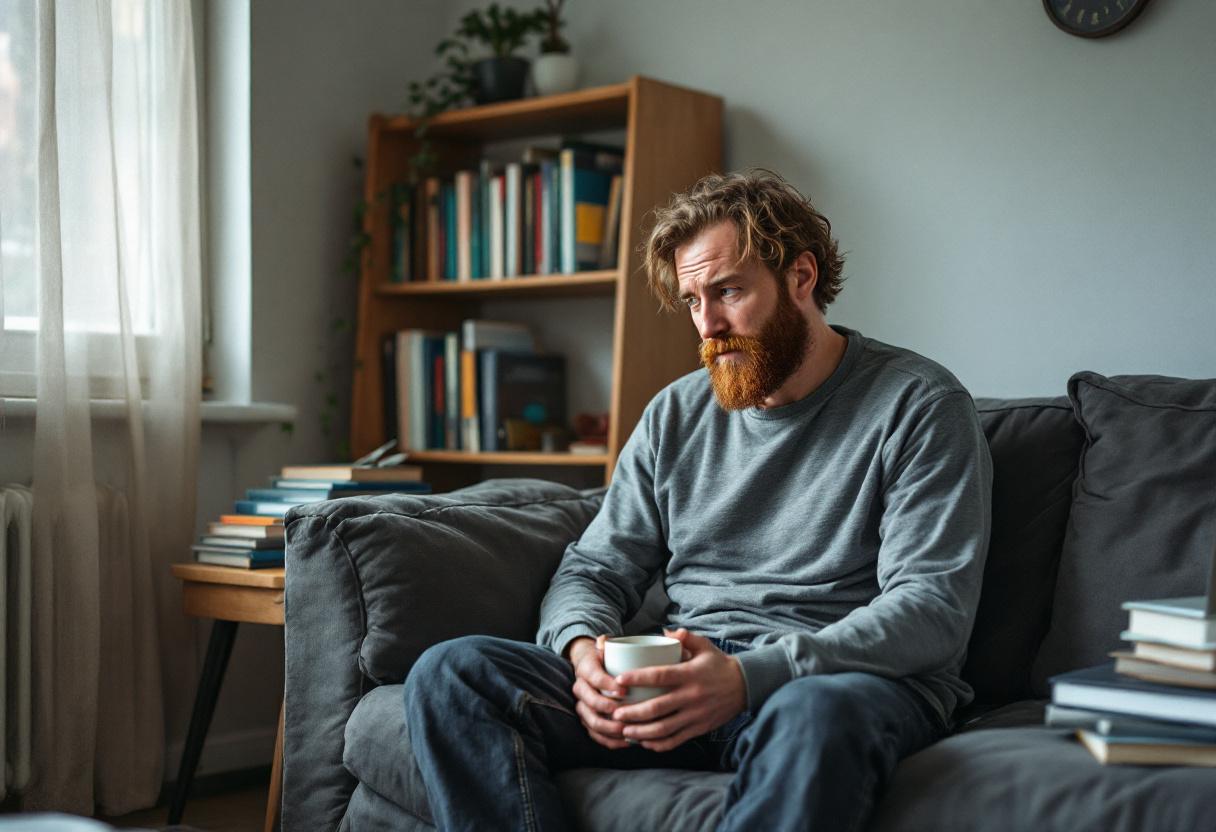
TAKOMA PARK, Md. — The apartment above the vegan bakery on Carroll Avenue has a view, if one leans toward the window, of a sidewalk on which, twice in the previous hour, a woman had passed carrying a tote bag that read “VOTE.” Brendan Vossmeier, 34, was not looking out the window. Mr. Vossmeier was sitting on a couch the color of wet slate, holding a ceramic mug of tea that had, some minutes earlier, stopped being warm. He had been describing, at length, his politics.
“I haven’t voted since 2012,” Mr. Vossmeier said, setting the mug on a side table that had been, until recently, a stack of books. “And at some point — I want to say 2019, maybe 2020 — I realized that what I was doing wasn’t nothing. It was a position. A refusal. And a refusal is, like, a whole thing.”
Mr. Vossmeier, who describes himself on a personal Substack that has not posted since March 2023 as “a writer, organizer, and quiet threat to the status quo,” has not held regular employment since December 2022 and has not finished a novel he began, he said, “around the Obama years.” He has, however, declined to cast a ballot in thirteen consecutive federal, state, and municipal elections — a record he now cites as evidence of what he calls “a sustained and material act of resistance against the patriarchy.”
It is, by any measure, a sustained act.
“Think about who built this system,” Mr. Vossmeier said, gesturing toward a bookcase on which stood nine books, four of them duplicate copies of All About Love by bell hooks. None of the copies showed any visible signs of having been opened. “Men. White men. The voting booth is, structurally, a patriarchal object. You step into it, you’re playing their game. I’m not playing their game. That’s — that’s the work.”
Dr. Cassandra Murch, a senior fellow at the Center for Nonparticipation Studies, said that Mr. Vossmeier’s position exemplifies a phenomenon she and her colleagues have termed “retroactive principle formation” — a gradual process by which chronic inaction acquires, after the fact, an ideological architecture that did not accompany its original commission.
“The subject typically cannot identify the moment at which their failure to vote became a political stance,” Dr. Murch said in a telephone interview from her office in Washington. “They report, rather, that the two concepts merged over time, in the manner of a long marriage.”
In a paper forthcoming in the Journal of Civic Engagement Studies, Dr. Murch and her co-authors estimate that retroactive principle formation affects “several million” American adults, a majority of whom, when surveyed, describe their nonvoting as a “conscious stance” despite being unable to name a single member of the House committee on which their own representative sits.
Mr. Vossmeier could not name his current congressional representative, a fact he did not consider relevant. He considers the naming of representatives “part of the theater.” He could not name either of his United States senators. Asked to identify the Speaker of the House, he paused for several seconds, then said, “See, this is exactly the kind of thing they want me distracted by.”
His mother, Linda Vossmeier, 68, of Gaithersburg, Md., who has voted in every election since 1978, including primaries and a 2003 water-board referendum, declined to characterize her son’s politics with precision. “Brendan has always been — I don’t want to say lazy,” she said. “Brendan has always been very thoughtful about what he doesn’t do.”
Amelia Kozlov, 29, a paralegal who has been dating Mr. Vossmeier for eleven months, said that she had initially assumed his nonvoting was a scheduling oversight. “I was going to, you know, help him register in time for the midterms,” she said, on the landing outside the apartment. “And he got very quiet, and then he explained that registering would be — and I am quoting him — ‘complicity.’ I did not press it. I think I’m supposed to admire it.”
Takoma Park is, Mr. Vossmeier said, “probably the perfect place to do this work.” The city — known for its progressive yard signs, its 1983 ordinance declaring itself a Nuclear-Free Zone, and a municipal code that has, since 1992, permitted noncitizens to vote in local elections — has long prided itself on the density of its civic engagement. Mr. Vossmeier has never attended a city council meeting. He has not read a ballot guide because he has never requested a ballot. He cannot recall the last time he opened mail from the Montgomery County Board of Elections, though he is fairly certain he still receives it. He considers this a form of discipline.
He has also, he noted, not donated to any political campaign, signed any petition, attended any protest, or posted on social media about any candidate since the Obama administration. Each of these, he said, represents an additional refusal, layered on top of the original one, in what he described as “a kind of stack.”
“People ask me, you know, ‘What if everyone did what you did?’” Mr. Vossmeier said. “And I tell them — well, then the patriarchy would fall. Right? That’s the answer. That’s the whole answer.”
Dr. Murch, asked to respond to this formulation, said that her research had not yet identified a single instance in which sustained individual nonparticipation had resulted in the collapse of a patriarchal governance structure. She acknowledged, however, that “absence of evidence is not, technically, evidence of absence,” and that the hypothesis remained, on the data currently available, unfalsified.
Back on Carroll Avenue, Mr. Vossmeier closed his eyes briefly. It was, by any measure, a long pause.
“It’s exhausting, honestly,” he said, after a moment. “But someone has to.”