Trump and Iran Both Declare Complete and Utter Victory in War, Each Citing the Other's Losses as Evidence

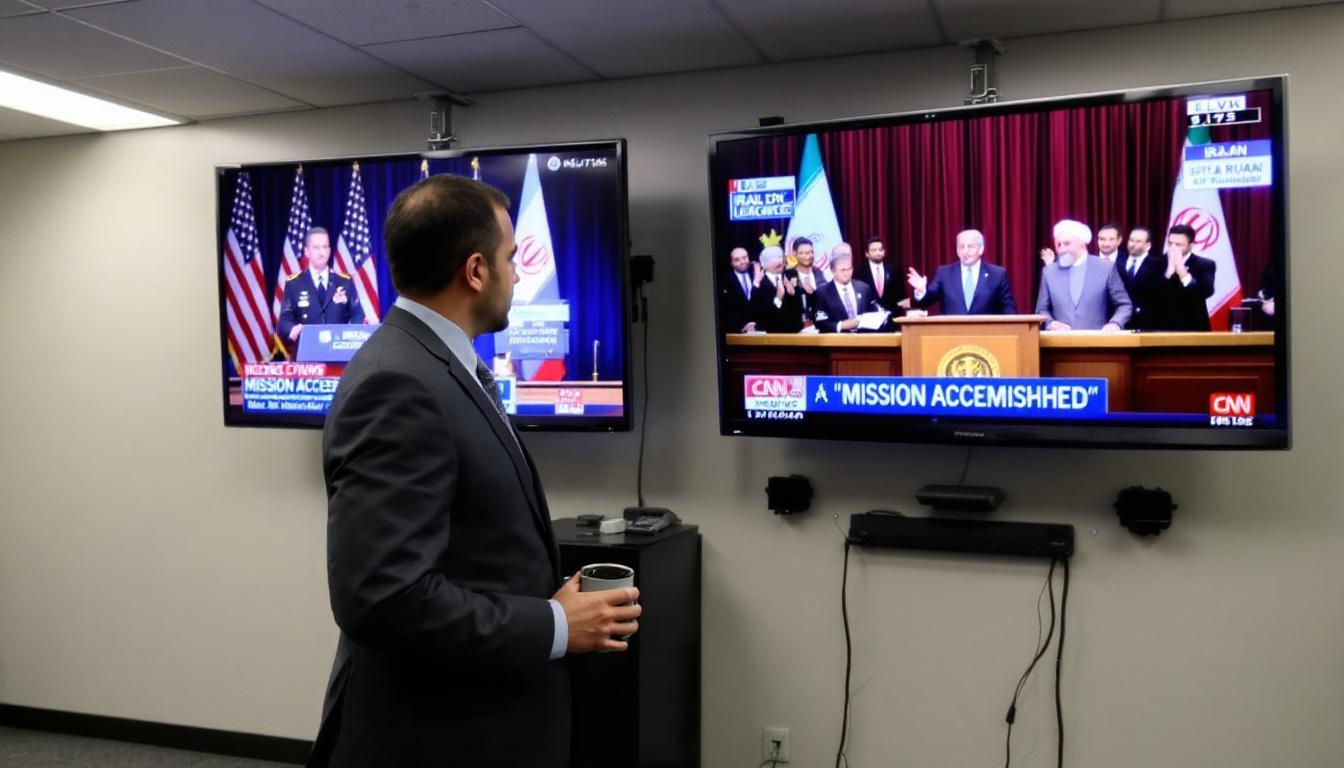
WASHINGTON — The United States and Iran simultaneously declared complete and unconditional victory in the three-month military conflict between the two nations on Saturday, in parallel announcements delivered within forty minutes of each other that used, according to a comparative textual analysis conducted by the Center for Doctrinal Pattern Analysis, “substantively identical rhetorical structures applied to mutually exclusive factual claims.”
President Trump, speaking from the White House Rose Garden beside a display board listing Iranian infrastructure targets struck since January, said the campaign had achieved “a victory the likes of which nobody has ever seen, maybe since Alexander the Great, and frankly, he didn’t have to deal with the media.” He described the outcome as “total,” “complete,” “historic,” and “beautiful,” and said Iran had been “reduced to rubble in the areas where rubble was the goal.” The president did not specify which areas those were.
In Tehran, Acting Supreme Leader Mojtaba Khamenei — who assumed authority in January after his father, Ayatollah Ali Khamenei, was killed in the opening American strike on a Revolutionary Guard command facility outside Isfahan — addressed a gathering at Azadi Square approximately forty minutes later. The younger Khamenei, whose ascension has not been formally ratified by the Assembly of Experts but has not been formally contested either, declared that the Islamic Republic had achieved what state media translated as “a divine and absolute triumph over the arrogant powers.” He described his father’s death as “the first and final cost of a war that achieved nothing else the enemy intended,” and said that Iran’s territorial sovereignty remained intact, its government operational, and its civilization “unbowed before a force that spent three months destroying what we will rebuild in six.” Iranian state television broadcast footage of government buildings still standing in central Tehran interspersed with clips of American antiwar protests, which it captioned, in English, as “The Enemy Admits Defeat.”
The simultaneous declarations created what interlocutors at the United Nations described as an unprecedented diplomatic circumstance. “In a conventional conflict termination, the parties negotiate terms that establish an agreed-upon narrative,” said Dr. Hendrik Lauritsen, a senior adviser on conflict resolution at the U.N. Department of Political and Peacebuilding Affairs. “In this case, both parties have independently arrived at the conclusion that they won, which presents certain challenges for the drafting of a ceasefire framework, as neither side recognizes there is anything to cease.”
The State Department issued a statement Saturday evening affirming that the United States “has achieved all stated and unstated objectives in the Iranian theater” and that the president would be outlining a “phased redeployment consistent with victory” in the coming weeks. When asked by reporters to identify the stated objectives, a senior department official, speaking on the condition of anonymity because the objectives had not been publicly stated, said, “The objectives were achieved, which is how you know what they were.”
Dr. Franklin Meier, the director of the Center for Doctrinal Pattern Analysis, said the rhetorical convergence between the two declarations was “analytically remarkable.” In a phone interview, he noted that both statements invoked divine or quasi-divine mandate, claimed the adversary had been fundamentally weakened, and assured domestic audiences that the sacrifices of the campaign had been vindicated. “The doctrinal architecture is mirrored almost perfectly,” Dr. Meier said. “The only structural difference is the proper nouns.”
On Capitol Hill, reaction followed what sources familiar with the negotiations described as established patterns. Senator Lindsey Graham, Republican of South Carolina, called the president’s declaration “a triumph for American strength and resolve” and urged the administration to “apply the lessons of this victory to the next theater, wherever that may be.” Senator Tim Kaine, Democrat of Virginia, said he was “deeply concerned that we are declaring victory in a conflict for which Congress never authorized the use of military force,” adding that the Senate Foreign Relations Committee would hold hearings “as soon as we can agree on what to call whatever just happened.”
Professor Diane Hollenbeck, the director of the Constitutional Executive Studies Program at Georgetown University, said the dual declarations illustrated what she termed “the sovereignty of narrative in post-evidentiary conflict.” She noted that the absence of a formal surrender, armistice, or negotiated settlement meant that “victory is, in this instance, a unilateral assertion rather than a bilateral condition — and because both parties have made the assertion simultaneously, the result is a conflict that has ended without producing a loser, which is, by most definitions, not how wars work.”
At the Pentagon, a senior defense official said the department was “reviewing the operational posture in light of the president’s announcement” but declined to characterize the outcome. “I would refer you to the president’s remarks for characterizations,” the official said. “Our role is to execute the mission, and we are confident the mission has been executed.” Asked what the mission was, the official said, “The one that was executed.”