An Irrational Devotion: How Pi Day Puns Have Debased the Noblest Constant in Mathematics

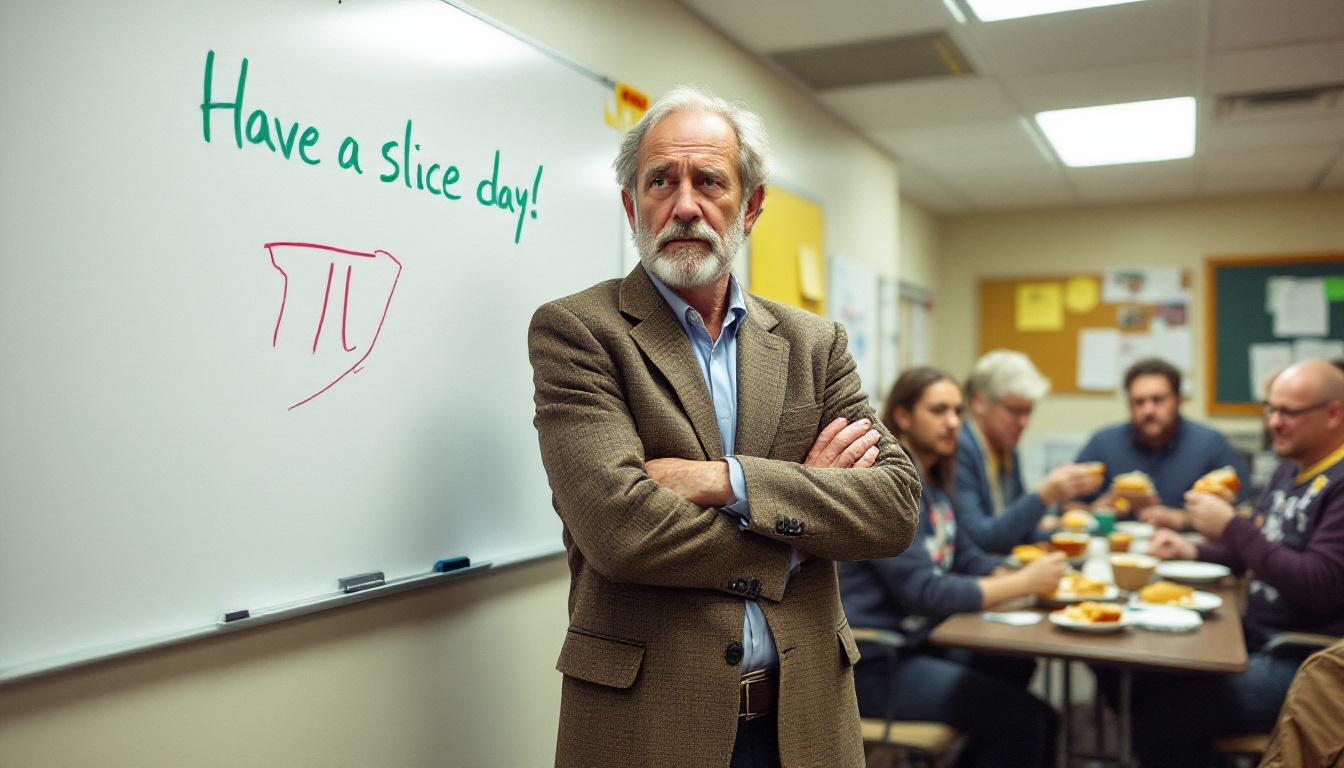
The Contrarian | By Kristoffer Kitchens
WASHINGTON — It is March 14th again, and one is obliged — by the calendar, by social media, by the insistent chirping of people who believe that the coincidence of a date and a decimal point constitutes an occasion — to endure the annual festival of wordplay that has attached itself to pi like a barnacle to the hull of a ship that deserved better. “It is irrational to think √(227/23) equals pi,” reads one offering that arrived in my inbox this morning, forwarded by a colleague who should have known better and, I suspect, did. “Thank God it’s pi day!” reads another, a construction so spiritually vacant that even the Almighty, if He exists, would decline to take credit for it.
Let us be clear about what is happening here. Pi — the ratio of a circle’s circumference to its diameter, a number that has occupied the finest mathematical minds since Archimedes first trapped it between the fractions 223/71 and 22/7 — has been reduced to a homophone. The entire annual observance rests on the fact that the Greek letter π, when transliterated into English, sounds like a baked good. That is the joke. That is the whole of the joke. It is, one might say, the crust and the filling and the meringue of the joke, and it was not particularly nourishing the first time it was served, which was — by the most charitable archaeological estimate — approximately 1988, when the physicist Larry Shaw organized the first Pi Day celebration at the San Francisco Exploratorium, an event that featured, inevitably, pie. Shaw has been dead since 2017 and can no longer be held accountable, but the tradition he unleashed has metastasized with the pitiless efficiency of a sequence that never terminates and never repeats.
Consider the state of the discourse. Each year on this date, office break rooms across the nation are colonized by store-bought pies of middling quality, accompanied by printouts bearing puns that would embarrass a Christmas cracker. “You’re the apple of my pi.” “Cutie pi.” “I’m just here for the π-zazz.” These are not jokes so much as they are surrenders — capitulations to the notion that a number whose digits have been computed to sixty-two trillion decimal places can be adequately honored by a dessert and a wink. The Bourbons of the mathematics department, having learned nothing and forgotten nothing, will recite digits from memory in the faculty lounge while eating a slice of something from Costco, and they will call this celebration.
It will not do to pretend that this is harmless. Dr. Renata Strauss, a professor of number theory at the University of Göttingen, told me in an email last week that she has stopped attending her department’s Pi Day gathering because “the puns have become so aggressive that they have displaced any actual discussion of mathematics, which I believe was nominally the point.” She described a recent event at which a graduate student presented a PowerPoint titled “Pi-Lingual: A Multilingual Survey of Pi Puns,” which contained pi-based wordplay in fourteen languages and no mathematics whatsoever. “He received a standing ovation,” Dr. Strauss wrote. “I have published forty-three papers on the distribution of prime numbers and I have never received a standing ovation.”
The deeper offense — and it is an offense, not merely an annoyance, though it is also an annoyance — is the reduction of one of the great mysteries of mathematics to the merely cute. Pi is transcendental. This is not a metaphor. It is a proven mathematical property, established by Ferdinand von Lindemann in 1882, meaning that pi is not the root of any polynomial equation with rational coefficients — it exists, in a precise and rigorous sense, beyond the reach of algebra. It is a number that appears unbidden in the equations governing quantum mechanics, general relativity, the normal distribution, and the oscillation of a pendulum. It is woven into the fabric of physical law with an intimacy that suggests either extraordinary coincidence or something deeper that we do not yet have the language to describe. And we have decided that the appropriate way to mark its existence is to say “easy as pi” and eat a tart.
One might be forgiven for thinking that the pun — that lowest form of wit, as Samuel Johnson may or may not have said, though it hardly matters because the observation is self-evidently correct — is at least being deployed in the service of mathematical enthusiasm. This is the defense mounted by Pi Day’s apologists, who argue that the puns and the pie function as a gateway, a way of making mathematics accessible, of inviting the uninitiated into the temple. But a gateway that leads only to more puns is not a gateway. It is a cul-de-sac. No child has ever eaten a slice of pie on March 14th and subsequently derived the Euler identity. No adult has ever read “Thank God it’s pi day!” on a coffee mug and been moved to investigate the Basel problem. The puns do not lead anywhere. They are their own destination, and the destination is a break room with crumbs on the table and a printout that says “Have a π-fect day!” taped to the microwave.
I do not object to the celebration of mathematics. I object to its domestication — to the notion that the appropriate posture before a number that has humbled every civilization that has attempted to pin it down is the posture of a person making a face while holding a pie. Archimedes did not die at the hands of a Roman soldier so that we might Instagram our crusts. Euler did not go blind computing infinite series so that a regional sales manager could send an email with the subject line “Pi-day deals that are NOT irrational!” Ramanujan did not produce his extraordinary formulas from the depths of colonial deprivation so that a bakery in Portland could sell something called a “Tau-talitarian Cream Pie” at a twenty-percent markup.
The number deserves better. We deserve better. And if we cannot muster the seriousness to contemplate a constant that connects the circumference of every circle ever drawn to the deepest structures of physical reality without reaching for a pastry pun, then perhaps the holiday we truly need is one devoted to examining why we cannot sit with the genuinely mysterious for even a single day without turning it into a bit. That holiday, I suspect, would have no puns, no pie, and no attendance whatsoever — which is, I confess, precisely the sort of gathering I would attend.