Millions Observe National Hey Day by Shouting Single Word at Complete Strangers
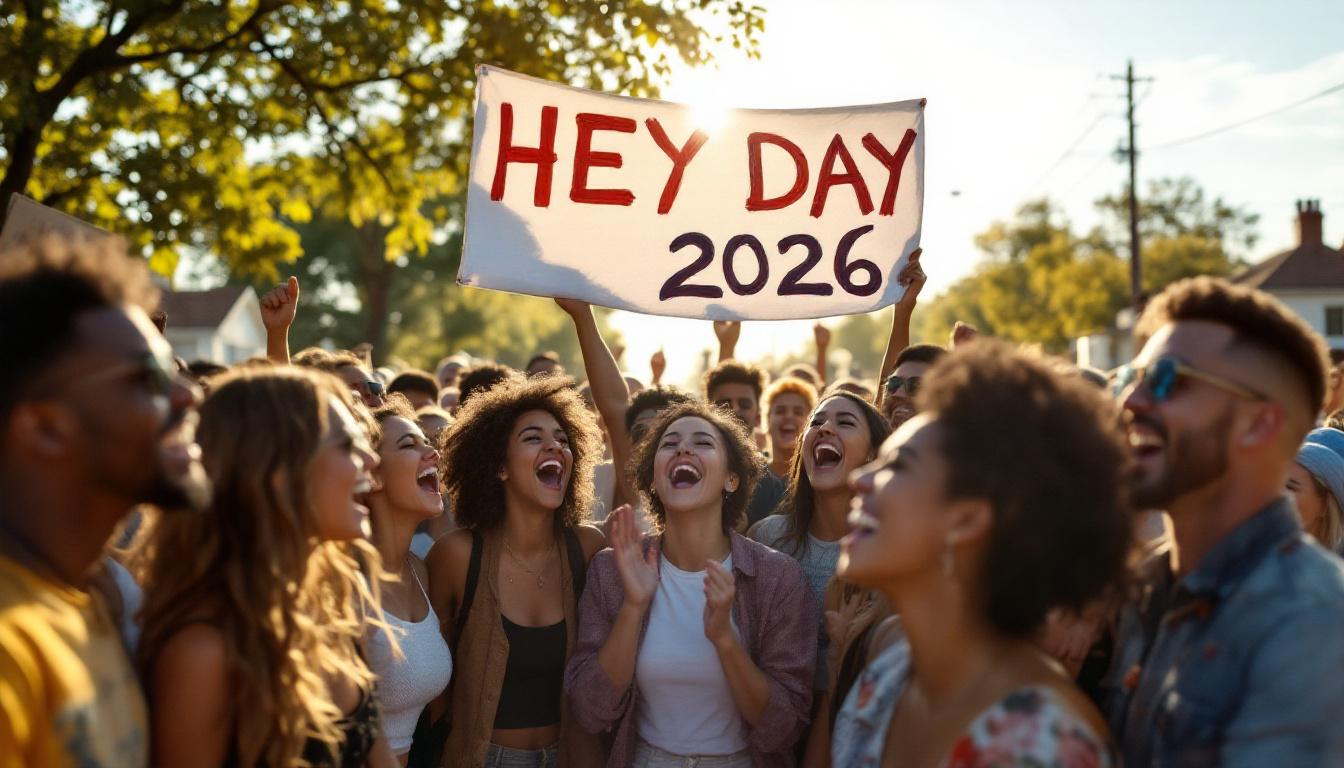
DAYTON, Ohio — Across the nation on Friday, Americans stepped outside their homes, turned toward the nearest available person, and shouted “Hey” at full volume, continuing a tradition that organizers say has grown every year since its informal founding in 2019 and now constitutes the country’s most widely observed unofficial holiday.
National Hey Day, which falls on May 30, asks only that participants greet at least one stranger with a loud, sustained “Hey” before sundown. No other words are required, encouraged, or, according to the National Hey Day Foundation’s guidelines, permitted.
“The purity of the tradition is what makes it work,” said Dr. Eleanor Voss, a cultural anthropologist at the University of Michigan who has studied Hey Day since its inception. “You are not saying hello. You are not saying excuse me. You are saying ‘Hey,’ which communicates everything and nothing simultaneously. That is its power.”
The holiday traces its origins to a 1992 Far Side comic strip by Gary Larson, in which a device that translates dog barks reveals that every bark, regardless of context or inflection, simply means “Hey.” The strip circulated for decades as a minor curiosity before a Facebook group devoted to reenacting it gained 1.4 million members in a single week in early 2019, an event sociologists have described as “not fully explainable.”
By 2022, Hey Day had been formally recognized by municipal proclamation in more than three hundred cities. Congress has twice declined to make it a federal holiday, though a nonbinding resolution praising “the spirit of Hey” passed the Senate 94 to 6 in 2024.
In Dayton, where the observance has become a point of civic pride, participants began lining East Third Street before dawn. Mayor Cynthia Bartell opened the festivities by shouting “Hey” into a microphone from the steps of City Hall, a moment broadcast live on local television.
“It never gets old,” said Gerald Toomey, 58, a retired electrician who has attended every Dayton Hey Day since 2020. “You look someone in the eye, you say ‘Hey,’ they say ‘Hey’ back. That’s the whole thing. People try to complicate it, but that’s the whole thing.”
Not everyone agrees on technique. A persistent schism divides those who favor a short, percussive “Hey” — delivered as a single sharp syllable — from adherents of the so-called Long Hey, a drawn-out version that can last several seconds and has been known to alarm bystanders unfamiliar with the holiday. The National Hey Day Foundation has declined to endorse either method, stating only that the greeting must be “audible and sincere.”
“I do the long one,” said Patricia Muñoz, 34, a dental hygienist in Phoenix who estimated she had said “Hey” to more than two hundred people by noon. “You really let it build. You let the person know you see them. Some people do the short one, and I respect that, but I don’t think they’re getting the full experience.”
Workplace participation has also surged. A survey conducted by the Society for Human Resource Management found that 61 percent of employers now permit employees to observe Hey Day during business hours, up from 23 percent in 2022. Several Fortune 500 companies, including Target and Procter & Gamble, issued internal memos encouraging staff to greet colleagues exclusively with “Hey” for the duration of the workday.
Dr. Voss, the anthropologist, said the holiday’s appeal lies in its radical simplicity. “We live in an era of tremendous complexity,” she said. “National Hey Day strips all of that away. For one day, you don’t have to be interesting. You don’t have to be clever. You just have to be loud.”