Inflexible Man Has to Take Off Shoes to Tie Them
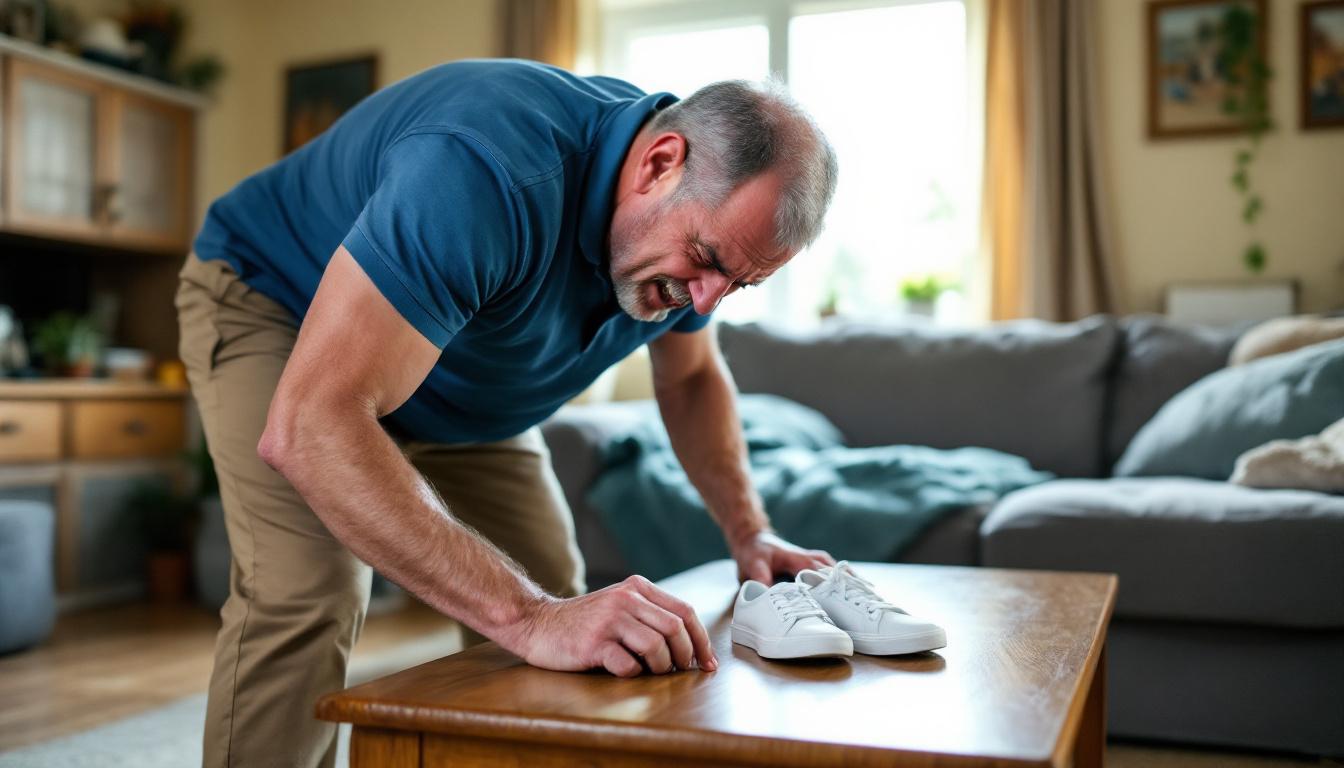
CEDAR RAPIDS, Iowa — A local man has been forced to adopt what biomechanics researchers are calling a “profoundly inefficient footwear protocol” after discovering that the only way he can tie his shoes is to first remove them entirely, tie them on a flat surface, and then slide his feet back in.
Kevin Durnell, 43, a regional sales coordinator, said he first noticed the limitation roughly six years ago but did not seek medical attention until last fall, when a colleague observed him unlacing, removing, retying, and reinserting both shoes in a Panera Bread parking lot before a client lunch.
“I thought everyone did this,” Durnell said, seated in his living room in a pair of meticulously pre-tied New Balance 608s. “You take them off, you tie them on the floor where you can see what you’re doing, and you put them back on. It’s not complicated.”
His podiatrist, Dr. Angela Rickman, said it is, in fact, extremely complicated. “What Kevin is describing is a multi-step workaround for what should be a single continuous motion,” Dr. Rickman said. “Most adults can reach their own feet while wearing shoes. Kevin cannot. He has, to his credit, developed an elaborate system to compensate, but it is not how shoes are supposed to work.”
Durnell’s wife, Karen Durnell, confirmed that the household switched entirely to slip-ons and loafers in 2022, calling the decision “an act of mercy for everyone involved.” She described an incident at their daughter’s soccer game in which her husband removed both shoes on the sideline, tied them with the focus and deliberation of a man defusing an explosive device, and then struggled for nearly two minutes to get his feet back into them without loosening the knots.
“He was so proud of himself,” she said. “The game was over.”
Dr. Marcus Holt, director of the Human Mobility Lab at the University of Iowa, said Durnell’s case, while extreme, reflects a broader trend of declining flexibility among American men in their forties. “We are seeing an entire generation of men who cannot touch their toes, who groan audibly when they bend over, and who treat any object below knee level as essentially unreachable,” Dr. Holt said. “Kevin is simply the logical endpoint.”
Durnell said he has no plans to pursue physical therapy and considers his current system “optimized.” He recently purchased a long-handled shoehorn, which he described as “life-changing,” though he acknowledged he still cannot use it while standing.